History ·
Operation Commando Lava: The U.S. Attempt to Sabotage with Soap
In 1967 the Pentagon decided that if monsoon mud slowed the enemy, the answer was to make more mud — by dropping nineteen-and-a-half tons of detergent on the Ho Chi Minh Trail.
By The Captain
In warfare, one of the oldest and surest ways to defeat an enemy is to choke their logistics — to starve their front lines of food, ammunition, and reinforcements. Yet in Vietnam, the United States found itself waging an increasingly desperate war against geography itself. The Ho Chi Minh Trail — a vast spiderweb of jungle roads and footpaths through Laos and Cambodia — fed the North Vietnamese war machine in ways that seemed impervious to bombs, chemical defoliants, or the most elite special operations units America could muster. When conventional bombing campaigns failed to stop the flow, the Pentagon’s imagination took a strange turn. In 1967, someone decided that if monsoon mud slowed the enemy, then the answer was obvious: make more mud. Thus was born one of the most absurd military experiments of the Cold War — Operation Commando Lava.
The Birth of a Bizarre Idea
By mid-1967, the American bombing campaign known as Rolling Thunder had been hammering North Vietnam for over two years. Despite the tonnage dropped — more than all the bombs used in World War II — the Ho Chi Minh Trail endured.¹ Air Force historian Mark Clodfelter later noted that *“no amount of ordnance could permanently interdict a jungle road that could be rebuilt by hand in a single night.”*² Frustration at this reality led to a torrent of strange projects. The Air Force had already deployed Operation Ranch Hand, using Agent Orange to burn away jungle cover. Secret teams from the Studies and Observations Group (SOG) crossed into Laos and Cambodia to plant mines and sensors.³ Still, the trucks kept rolling.
That’s when a handful of Pentagon scientists decided the problem wasn’t the bombs — it was the dirt. If only the soil could be altered to trap vehicles in a permanent monsoon. The Air Force’s environmental modification division, already experimenting with cloud seeding under Project Popeye, drafted a proposal to *“enhance soil plasticity.”*⁴ In plain English: turn dirt into goo.
The Pentagon greenlit the idea, and Dow Chemical was brought in to provide the magic ingredient. Dow’s scientists suggested a water-absorbing polymer — a compound suspiciously similar to the household product Calgon, best known for keeping your bathtub bubbly. According to one project summary, the compound would *“retain moisture, thereby extending the natural muddying effect of precipitation.”*⁵ One might imagine the brainstorming session ending with someone exclaiming, “Gentlemen, we’re going to win the war — with soap!”
Enter Operation Commando Lava
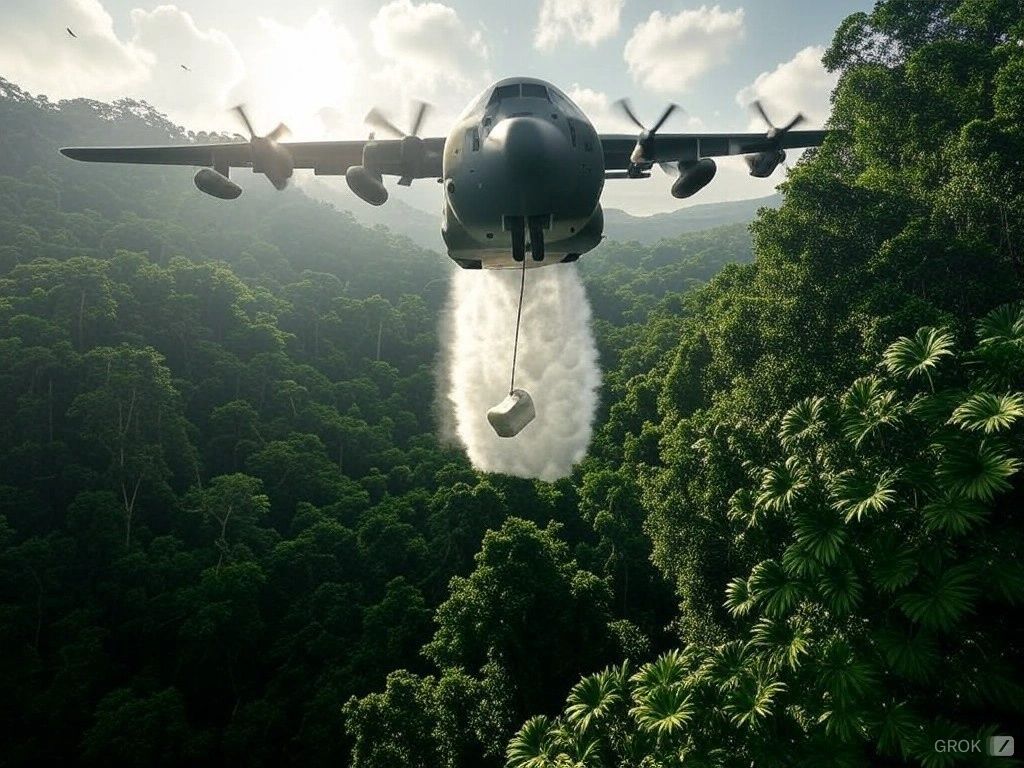
The Air Force, never one to shy away from a code name, dubbed the mission Operation Commando Lava, as if the act of dumping detergent across Laos somehow carried the grandeur of a Bond movie. In July 1967, three C-130A Hercules aircraft of the 315th Air Commando Wing were fitted with modified dispensers. Each sortie carried roughly forty-four sacks of powdered compound — nineteen and a half tons of the stuff — bound for fifty-nine drop zones, mostly in the notorious A Shau Valley and along Route 922.⁶
Reality quickly intruded. One aircraft suffered hydraulic failure after taking small-arms fire near its target, forcing an emergency landing. Others encountered foul weather, visibility problems, and difficulties with dispersal systems.⁷ Despite these obstacles, the crews dutifully completed several missions, scattering bath soap across the jungle in what must have been one of the least dignified uses of the mighty Hercules.
Soap, Sweat, and Failure
The outcome was predictable. A declassified report from the Department of the Air Force dryly concluded that the compound *“failed to produce the desired effect.”*⁸ In some areas, the material never dissolved. In others, it created a thin layer of slippery muck that North Vietnamese drivers simply avoided. Intelligence photographs showed the Trail as busy as ever. Leary’s 1997 Air Power History analysis noted that *“Commando Lava had no measurable impact on the enemy’s logistic operations.”*⁹
Dow’s polymer didn’t so much trap the enemy as mildly inconvenience local wildlife. After-action humor among U.S. personnel reportedly described the mission as “the world’s largest bubble bath.” The irony was painful: while America dropped literal tons of soap over Southeast Asia, its leadership remained mired in an unwinnable ground war.
What Commando Lava Tells Us
Beneath the absurdity, Operation Commando Lava reveals the deeper pathology of America’s war in Vietnam — a blind faith in technology to solve a political and human problem. RAND historian Mai Elliott described this era as one where *“scientific optimism merged with strategic frustration.”*¹⁰ Whether through weather modification (Project Popeye), chemical defoliation (Ranch Hand), or now “mud enhancement,” the Pentagon believed that the right chemical or machine could substitute for strategy.
Mark Clodfelter argues that the Air Force’s approach to Vietnam reflected *“a belief that air and science could triumph over insurgency and will.”*¹¹ Commando Lava was the logical conclusion of that mindset: an attempt to chemically engineer victory by manipulating the landscape itself. It didn’t work, of course — but it perfectly captured the bureaucratic madness of the time.
Conclusion: Soap and Hubris
By the time Commando Lava was quietly shelved later that year, its lessons were already obvious. Science could not fix a war that lacked strategic coherence. If anything, the episode stands as a surreal monument to the collision of American ingenuity and arrogance. Perhaps the final word belongs to the anonymous aircrew who participated in the mission and later quipped, “We didn’t stop the trucks, but we sure had the cleanest mud in Laos.”
In the end, Operation Commando Lava is more than a historical footnote — it’s a parable about the limits of technology and the persistence of folly. The United States tried to wash away its problems in Vietnam, and in doing so, only proved that some kinds of dirt cannot be cleaned.
Notes
- Robert F. Futrell, The United States Air Force in Southeast Asia: The Advisory Years to 1965 (Washington, D.C.: Office of Air Force History, 1981), 293.
- Mark Clodfelter, The Limits of Air Power: The American Bombing of North Vietnam (Lincoln: University of Nebraska Press, 2006), 214.
- Timothy N. Castle, At War in the Shadow of Vietnam: U.S. Military Aid to the Royal Lao Government, 1955–1975 (New York: Columbia University Press, 1993), 142–43.
- U.S. Department of Defense, The Pentagon Papers: Report of the Office of the Secretary of Defense Vietnam Task Force (Washington, D.C.: Government Printing Office, 1971), 384.
- U.S. Air Force, Project Commando Lava: Final Report (Washington, D.C.: Department of the Air Force, 1967), 3.
- William M. Leary, “Operation Commando Lava: The Air Force’s ‘Soap Bombs’ of Vietnam,” Air Power History 44, no. 2 (Summer 1997): 31.
- Leary, “Operation Commando Lava,” 33.
- U.S. Air Force, Project Commando Lava: Final Report, 7.
- Leary, “Operation Commando Lava,” 38.
- Mai Elliott, RAND in Southeast Asia: A History of the Vietnam War Era (Santa Monica, CA: RAND Corporation, 2010), 229.
- Clodfelter, The Limits of Air Power, 219.
Bibliography
Buckingham, William A. Jr. Operation Ranch Hand: The Air Force and Herbicides in Southeast Asia, 1961–1971. Washington, D.C.: Office of Air Force History, 1982.
Castle, Timothy N. At War in the Shadow of Vietnam: U.S. Military Aid to the Royal Lao Government, 1955–1975. New York: Columbia University Press, 1993.
Clodfelter, Mark. The Limits of Air Power: The American Bombing of North Vietnam. Lincoln: University of Nebraska Press, 2006.
Elliott, Mai. RAND in Southeast Asia: A History of the Vietnam War Era. Santa Monica, CA: RAND Corporation, 2010.
Futrell, Robert F. The United States Air Force in Southeast Asia: The Advisory Years to 1965. Washington, D.C.: Office of Air Force History, 1981.
Leary, William M. “Operation Commando Lava: The Air Force’s ‘Soap Bombs’ of Vietnam.” Air Power History 44, no. 2 (Summer 1997): 30–39.
Tilford, Earl H. Jr. Setup: What the Air Force Did in Vietnam and Why. Maxwell Air Force Base, AL: Air University Press, 1991.
U.S. Air Force. Project Commando Lava: Final Report. Washington, D.C.: Department of the Air Force, 1967. Declassified, National Archives and Records Administration, College Park, MD.
U.S. Department of Defense. The Pentagon Papers: Report of the Office of the Secretary of Defense Vietnam Task Force. Washington, D.C.: Government Printing Office, 1971.
Originally published at the live site .