History ·
Celebrating the Legacy of the UH-1 Huey
From Bell Model 204 to the modern UH-1Y — the most recognized helicopter in the world and the doctrine of air mobility it carried into Ia Drang and beyond.
By The Captain
On the 23rd of April 2018 I had one of the proudest moments in my life. That was the day I pinned my son’s crew chief wings on at his graduation from Crew Chief training at Camp Pendleton. Patrick is a third-generation Marine and a second-generation aircraft technician on the UH-1 and AH-1 platforms. It was an enormously proud day when I was able to pin his wings on him.
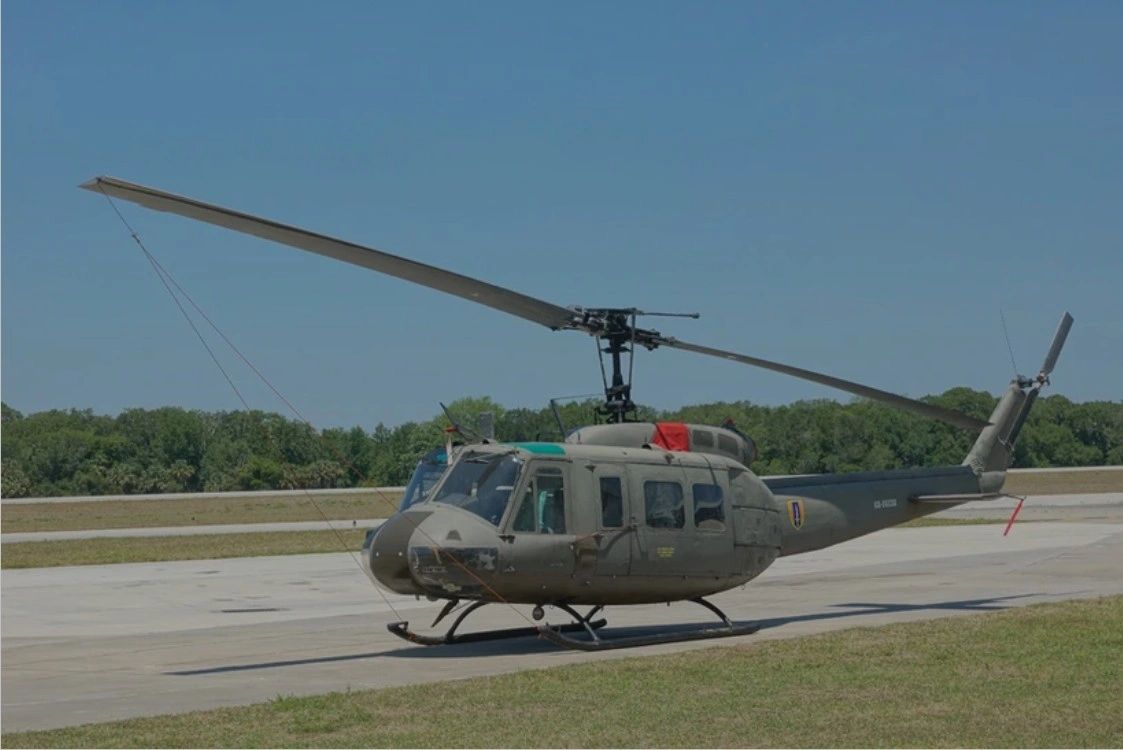
The UH-1 is the most recognized helicopter in the world as it was the workhorse of the Vietnam War. There were UH-1 variants in every service. The Army retired the UH-1 in 2005, and the National Guard in 2010. The Air Force still operates a few twin-engine UH-1N for jobs such as missile field patrols. The Marine Corps has upgraded the trusty UH-1N model to the UH-1Y. This is a massive upgrade that will solve a good many logistical issues for the Marine Corps as the UH-1Y and the AH-1W now share 85% of their parts. This reduces the spare inventory that needs to be maintained and makes maintenance a little easier to complete.
Whenever I see a picture, video, or just a UH-1 helicopter in the air, my brain pictures it skimming the tree tops, guns hanging from the side, and Creedence Clearwater Revival driving with the beat of the blades in the background. OK — too many movies as a kid.
Origin and Evolution
After the success Bell had in Korea with the Bell 47, they designed its next iteration of helicopter. Originally designated Bell Model 204 XH-40, it took its first flight in 1956. This helicopter would be identified as the UH-1 Iroquois but would be affectionately known as “Huey.” For the uninitiated, UH stands for Utility Helicopter. This designation means it can be used to transport troops and cargo, medevac, and assault. Like all good gear, it’s all about the accessories. Huey was so successful that over 16,000 were built between 1955 and 1976.
The initial Huey was powered by a Lycoming T53 Turboshaft engine which produced 770 Shaft Horsepower driving a twin-bladed rotor system. Stability was augmented using a simple bar across the rotor system to reduce instability and vibration. By 1966, the Huey had been upgraded with a more powerful T-53 producing 1,100 horsepower. The UH-1C’s useful load was 4,673 lbs. A useful load is what the aircraft can carry — this includes fuel, crew, and cargo. The UH-1C can carry 242 gallons of fuel when full. Since jet fuel weighs in at 6.75 lbs per gallon, the useful load is reduced to 3,039.5. There were countless times when these aircraft flew overweight.
Comparatively, the newest iteration of the UH-1Y has twin General Electric T700-GE401C turboshaft engines weighing in at a total of 1,800 Shaft Horsepower each! These monsters drive a four-bladed rotor system that can lift a useful load of 6,660.2 lbs to a max speed of 170 MPH and is controlled by a state-of-the-art glass cockpit and Full Authority Digital Engine Control (FADEC). That’s almost double that of her ancestor.
Vietnam: Slicks and Gunships
In Vietnam, the Huey had two basic varieties. “Slicks” carried combat troops into battle, resupplied them during a fight or patrol, and took any wounded out. “Gunships” would be loaded up with guns and rockets to support the trooper on the ground. Among the armaments that the early Huey Gunships carried were M-60 machine guns mounted in the doors, 2.75- and 5-inch unguided rockets as well as .30 caliber coaxial mounted machine guns. These Gunships helped to suppress Viet Cong and North Vietnamese Army attacks to help the embattled soldiers on the ground survive.
Air Mobile Doctrine
Of course, you cannot develop a great tool like the UH-1 and not have an effective doctrine to use it. In 1963, the Army released FM-57-35 Air Mobile Operations, which is on full display in the Ia Drang Valley operation with Lt. Col. Hal Moore and the 1st Battalion, 7th Cavalry Regiment of the 1st Cavalry Division (Air Mobile). As Vietnam progressed, the Army would fine-tune the concept and make it an amazingly effective doctrine. The helicopter was now able to take maneuver warfare to a new level.
The Marine Corps puts UH-1Y and AH-1Z together in Attack Squadrons. For Marine Expeditionary deployments, aircraft and crews are detached to composite squadrons made up of UH-1Y, AH-1Z, CH-53E, V-22, and in some cases Harriers or F-35. Under Force Design 2030, several Helicopter Marine Light Attack squadrons have been deactivated. However, the Corps is realizing this was a mistake and is working to reactivate two of them due to operational tempo.
The Modern Huey
The role of the Huey has changed a bit since those days. Marines still use the UH-1Y to carry Marines in and out of places and can still be set up in a gunship role. Among the armaments that Yankee carries are the .50 caliber machine gun, GAU-17 minigun, M240 7.62mm machine gun, and Hydra 70 2.75-inch rocket pods. It can also be outfitted with special mission equipment such as the Night Eagle sensor package, Search and Rescue package to include a hoist, or a radio package for command and control. Yankee also sports a top-of-the-line countermeasures system to protect against surface-to-air and air-to-air threats. The Huey is a very versatile machine and when teamed up with the AH-1Z, a Marine attack squadron is a powerful unit.
Heroes of the Huey
Every year here in Melbourne, FL, we have an all-veteran reunion weekend. I meet many vets from Vietnam, and they all have the same sentiment: when they were in a tight spot, the sight of a Huey meant salvation. The pilots in Vietnam were a breed of their own. There were great feats of heroism. Major Bruce Crandall won the Congressional Medal of Honor for his actions in the Ia Drang Valley. His citation says it all:
“Major Bruce Crandall distinguished himself by extraordinary heroism as a Flight Commander in the Republic of Vietnam while serving with Company A, 229th Assault Helicopter Battalion, 1st Cavalry Division (Airmobile). On 14 November 1965, his flight of sixteen helicopters was lifting troops for a search and destroy mission from Plei Me, Vietnam, to Landing Zone X-Ray in the Ia Drang Valley. On the fourth troop lift, the enemy had targeted Landing Zone X-Ray. As Major Crandall and the first eight helicopters landed to discharge troops on his fifth troop lift, his unarmed helicopter came under such intense enemy fire that the ground commander ordered the second flight of eight aircraft to abort their mission. As Major Crandall flew back to Plei Me, his base of operations, he determined that the ground commander of the besieged infantry battalion desperately needed more ammunition. Major Crandall then decided to adjust his base of operations to Artillery Firebase Falcon to shorten the flight distance to deliver ammunition and evacuate wounded soldiers. While medical evacuation was not his mission, he immediately sought volunteers and with complete disregard for his own personal safety, led the two aircraft to Landing Zone X-Ray. Even though the landing zone was still under relentless enemy fire, Major Crandall landed and proceeded to supervise the loading of seriously wounded soldiers aboard the aircraft. Major Crandall’s voluntary decision to land under the most extreme fire instilled in the other pilots the will and spirit to continue to land their own aircraft, and in the ground forces the realization that they would be resupplied and that friendly wounded would be promptly evacuated. This enhanced morale and the will to fight at a critical time. After his first medical evacuation, Major Crandall continued to fly into and out of the landing zone throughout the day and into the evening. That day he completed a total of twenty-two flights, most under intense enemy fire, retiring from the battlefield only after all services had been rendered to the infantry battalion. His actions provided critical resupply of ammunition and evacuation of the wounded. Major Crandall’s daring acts of bravery and courage in the face of an overwhelming and determined enemy are in keeping with the highest traditions of the military service and reflect great credit upon himself, his unit, and the United States Army.”
Closing
At the end of the day, the UH-1 is still a great machine and continues to be improved. A good friend of mine crewed CH-47’s in the Army and he loves to send me pictures of UH-1’s being carried out of places by a CH-47. I always must remind him that when the last CH-47 goes to the boneyard, the crew will be picked up in a Huey.
If you find this interesting, I highly recommend reading the book Chickenhawk by Robert Mason. He was an Air Cav pilot in Vietnam, and it’s one of my favorite books. I also recommend checking out Scramble the Seawolves. It tells of the pilots who supported riverine operations during Vietnam using the UH-1H.
Bibliography
Bell Helicopter. “Bell UH-1Y — The Ultimate Utility Helicopter.” Bell Helicopter Textron Inc. https://www.bellflight.com
Burgess, Richard R. “Marine Corps Deactivates Two Helo Squadrons, One Temporarily.” Seapower Magazine, April 26, 2022. https://seapowermagazine.org
Congressional Medal of Honor Society. “Bruce P. Crandall — Vietnam War — U.S. Army — Medal of Honor Recipient.” https://www.cmohs.org
Lime, Chris. “More Than Just a Helicopter: The ‘Huey’ Became a Symbol of the Vietnam War.” Air & Space Magazine, Smithsonian Institution, February 2021. https://www.smithsonianmag.com
Museum of Flight. “Bell UH-1H Iroquois (Huey).” https://www.museumofflight.org
NHA Historical Society. “UH/HH-1B, C, E, L, K, M (Bell 204/205) Huey/USMC ‘Slick’ Helicopter.” Naval Helicopter Association Historical Society. https://www.nhahistoricalsociety.org
Pullman, Ignacio. “The UH-1 Iroquois ‘Huey’ Helicopter.” Warfare History Network, August 2007. https://warfarehistorynetwork.com
U.S. Army War College. “UH-1 Iroquois ‘Huey’ Helicopter.” Army War College. https://www.armywarcollege.edu
U.S. Government Accountability Office (GAO). Weapon System Sustainment: Aircraft Mission Capable Goals Were Generally Not Met and Sustainment Costs Varied by Aircraft. https://www.gao.gov
Originally published at the live site .