Born to Lead, Forged in Battle: Lewis Burwell 'Chesty' Puller
Lewis Burwell 'Chesty' Puller — five Navy Crosses, the legend at Henderson Field and Chosin, and the complicated, compassionate man behind the most decorated Marine in Corps history.
By The Captain
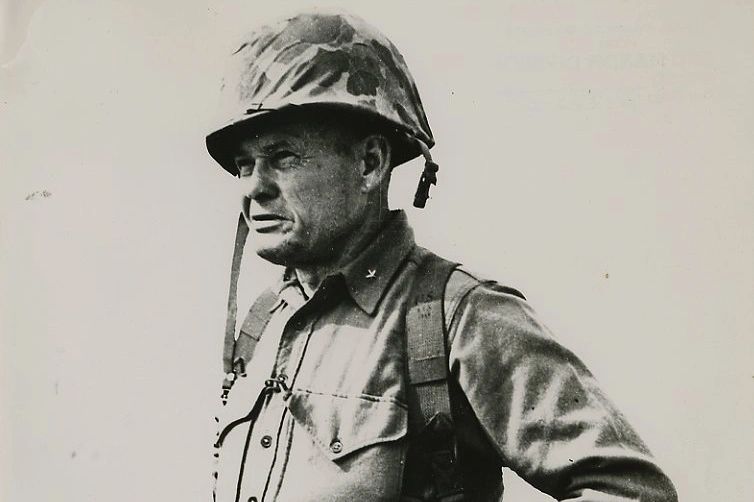
In the Captain’s Badass Club, one name is at the top: Chesty Puller.
Among Marines, there are many legends: Dan Daly, Smedley Butler, James Mattis, John Basilone — but one man stands above them all. His image adorns many walls around the Corps and beyond, and his name is spoken with respect and reverence. That man is Lewis Burwell “Chesty” Puller, a leader who epitomizes what it means to be a Marine. Known for leading men from the front, fiercely caring for his men, and inspiring generations, Puller became a larger-than-life figure. Yet beyond the legend lies a far more complex individual. Puller was not only a tenacious warrior but also a compassionate family man, lifelong learner, and master of his craft. It is this complexity — his blend of relentless leadership and human depth — that shaped him into the most revered Marine in history.
Early Years
Lewis Burwell Puller’s story begins on 26 June 1898. He was born in the small Virginia town of West Point into a strong southern family. Chesty’s grandfather fought and died for the Confederacy during the Civil War. Major John Puller was a cavalry officer that served under J.E.B. Stuart and would die in 1863 at Kelly’s Ford. Chesty would grow up on a hearty meal of tales of his grandfather and other Confederate leaders such as Stonewall Jackson, Robert E. Lee, and others. These stories would also shape the man that Lewis would become.
Another factor that shaped the young Chesty was that his father would pass away when he was ten and he would be raised by his mother, a strong and independent woman. After his father’s death, the family was under tremendous strain, so Chesty would do anything he could to earn money including working at a pulp mill and hunting small game that he could sell. This taught him self-sufficiency and how to manage money as he had to help support the family but also buy bullets to continue hunting with. These life events would mold the base of what Chesty would become.
In school, he had little interest in math or English classes. He devoured history and was an avid athlete as he played football, ran track, played baseball, and boxed. Lewis also devoured history books and loved to read. Among his favorite topics was Stonewall Jackson and Julius Caesar. It was in school too that he would begin to show his aptitude for leadership as he was the captain of his school’s track team and even led a senior skip day in 1917 because, “they can’t expel all of us!”
VMI and the Corps
Chesty would attend the Virginia Military Institute in 1917, as it was the premier school to attend before going to one of the Academies or enlisting as an officer candidate. He was in good company as his distant cousin George S. Patton, George C. Marshall, and his childhood hero Thomas J. “Stonewall” Jackson had all walked there. Throughout Chesty’s educational career, he would not be known for academic prowess but an undeterrable spirit and never giving up. Chesty would not finish at VMI, however, because he felt there was little he could learn about actual warfare there. Lewis would hear the beat of the drum and desire to go and fight in Europe as America entered the First World War. Chesty couldn’t be an Army officer at 17, but the Marines were more than happy to take him and off to Parris Island he went.
In July 1918, Chesty entered his destiny when he arrived at Parris Island. Because of his VMI experience, Lewis’s leadership and military bearing would be on full display. He was given a leadership role in his recruit platoon. Corporal John Desparre, one of Chesty’s drill instructors, was so impressed with his bearing and discipline that he would remark: “Hell, the kid gives me an inferiority complex. I’ve read some, but he knows von Clausewitz backwards — and dozens of guys I have never heard of.” After graduating as the platoon guide, he would begin non-commissioned officer training in October 1918. Here he would encounter more officers, and this time would lend to his view of them. He gained immense respect for ones that were enlisted men first, known as mustangs. Chesty concluded that mustang officers were better as they had been able to build valuable experience that made them better leaders and more prepared for combat.
5 November 1918 saw Chesty and his fellow Marines transit to Quantico, Virginia. There they prepared for their deployment to France, but the Armistice on 11 November would put a stop to that deployment. He would attend Officer Training school beginning 10 January 1919. Lewis’s performance during his training there was the same as boot camp and NCO school. He impressed his superiors and peers with his can-do attitude, military bearing, and love for the trade. Even his academic struggles during this course were filled with an indomitable never-quit attitude that helped him finish 128th of 231.
Unfortunately for Chesty and his classmates, two weeks after his commission in June 1919, he would be released from the Marine Corps due to post-war downsizing. On the advice and recommendation of Captain William Rupertus, he would be taken off the reserve officer status and enter the Haitian Gendarmerie as a Marine NCO in the capacity of Gendarmerie Lieutenant. Twenty-one-year-old Lewis Puller would finally find a fight. Haiti would add to his already solid foundation and build the combat leader he would become known for.
Haiti: First Combat
From 1919–1923, Chesty would be in the thick of it. On his very first mission, he ran into Haitian Cacos bandits. Though both sides were surprised, Chesty went default aggressive and attacked. He came out of the fight victorious and learned that quick action and aggressiveness on the battlefield wins the day. He would learn another lesson a short time later when on patrol, he observed a man on a beautiful horse across the river from their position. He mentioned to the man next to him that he thought it was an amazing horse and that he wished it was his. The Haitian immediately ordered the rider shot and the horse captured. In stunned disbelief, Chesty asked the man why he did that, and the man proudly replied that he always follows orders when given. The lesson Chesty would take away from this event is that when leading men, make sure to never make a statement that can be implied as an order.
He also learned the ins and outs of fighting small wars in the rough mountainous terrain of Haiti. His time hunting as a kid benefited him in hunting the Cacos Bandits. He perfected stalking them, ambushes, and rapidly transiting the countryside. He earned a reputation as a solid leader that was always up for the fight and able to finish every mission. Chesty earned the respect of his company though he pushed them hard by showing compassion when needed, learning Haitian Creole so he could communicate with them, and never showing fear. He also learned that he needed to push his men hard so they would be able to physically and mentally meet the job before them. One of these lessons came to light when he witnessed brutal treatment of one Haitian soldier when falling behind on a march. The NCO told Chesty that this treatment was better than what he would receive from the Cacos if they caught him when he fell behind on patrol. Cacos were known to torture Gendarmerie prisoners before killing them. The lessons Chesty learned during his tour of duty in Haiti confirmed his view of the leaders he admired in his readings. Stark courage is the best way to inspire your troops.
Back in the Corps
After much consternation and perseverance, with great recommendations from the Chief of the Gendarmerie and Major Alexander Vandegrift, Chesty would once again become a commissioned officer in the Marine Corps. He almost didn’t make the cut in 1922 due to poor test scores and went back to Haiti and served as Vandegrift’s adjutant. With his help, Chesty would be commissioned Second Lieutenant on 6 March 1924. He finished fifth in a class of ten. His first command was an artillery unit where he learned the importance of knowing your job and that trust and positive relationships with NCOs was paramount. Two weeks after checking into his command, he had to lead his battery in a live fire exercise that would be observed by the command and staff. Chesty went to the Gunnery Sergeant in charge and had him teach him everything about the guns, performing a fire mission, and the proper execution of the operation. This earned the respect of his Marines, and they performed well.
Chesty would then go on to lead the Marine Corps drill team, which today we know as the Silent Drill Team, to their first victory against the Army, Navy, and Coast Guard at the annual drill competition. When he showed up to command the drill team, Chesty told them that “we will bring home the cup, or die trying.” He drilled them hard and instilled pride in the unit. When the time came, the Marines won the competition. After that he would leave for Pensacola and attempt to become a pilot — which was not to be. Once again, his struggles in academics led to his failure to become a pilot. Chesty learned the mechanics but was declared not “suitable aviator material.”
His next duty would be leading a detachment in Hawaii as part of the Coastal Defense Force. When he arrived, he was appalled at the condition that he found his Marines in and set to work whipping them into shape. Chesty learned what was required of his Marines as part of the defense plan, acquired the equipment that they were required to have, and relentlessly drilled his Marines in their job — including marksmanship training and physical exercise to harden the men and prepare them for any fight. He also led by example by honing his own skills, including his expertise with the rifle and pistol. A great example of Chesty’s leadership skills was when he accidentally discharged a handgun. Being a stickler for firearms safety, he fined himself one hundred dollars and gave it to the men that witnessed it to buy the enlisted Marines some beer. This improved the standing of the hard-driving Puller among his Marines as he showed he was not above reproach.
Nicaragua and China
Chesty would find himself leading men in combat when he arrived in Nicaragua in 1928. Once again Chesty would become well known for his aggressive leadership and unwillingness to quit or give the enemy a break. Here he would also learn the art of jungle warfare that he would need in the coming war years in the Pacific. Chesty learned that he could move faster with less notice if they carried what they needed versus riding horses as other units did. He saw many engagements against the Sandinistas, and this is where he would win his first Navy Cross in 1930, the highest award in the Marine Corps. Nicaragua is also where Lewis would earn his moniker of “Chesty,” though there is not a clear story of how it came to be.
After his tour in Nicaragua, he would serve in China. Here he was able to witness the Japanese Army in action. Chesty saw how the detachment based near him performed daily marches, no matter the weather, carrying all their equipment. When compared to the American units there, Chesty surmised that the Japanese would be a considerable opponent, and that America would be in a fight against them before long. During this time, he would also hone his training and leadership skills while learning the art of foreign relations. Then, in 1932, he would return to Haiti for his second tour of duty. This second tour would only grow Chesty’s reputation as an aggressive combat leader who did not understand the concept of losing. He led men into more battles and built valuable experience for the fights where his legend would soar.
Chesty would also serve aboard the USS Augusta in China. When he arrived for duty, Captain Chester Nimitz informed him that he felt the Marine Detachment was unsatisfactory and if Chesty didn’t fix it, he would be gone as well. Well, never to be one to shrink from a challenge, Chesty went straight to work. Chesty immediately gathered his Marines on the deck and said:
“My name is Puller. I am glad to have been assigned to command you. We are going to work together, starting from scratch. We’ll see if we all can’t learn something and do a little bit for our country! Dismissed!”
And lead them he did. When his time aboard the Augusta ended, the Marine Detachment was the pride of the Marine Corps and Chesty earned the friendship and admiration of Nimitz. He would write in Chesty’s fitness report that “he had a very high sense of duty. He is a true leader who demanded — and received — the best from his subordinates.” The men were fond of the commander who they knew looked out for the welfare of each man in the unit.
Another place where Lewis Puller would shine was when he commanded the Officer Training School at the Philadelphia Naval Yard. There he was revered again for his leadership in creating a hard training regimen that was meant to build Marine leaders. One of his trainees would go on to command one of the most famous Marine squadrons of the Second World War, Greg Boyington. Boyington called Chesty “the greatest Marine of all!” Chesty impacted many of the young leaders who would go on to successful careers as Marines.
The Family Man
Here seems like a good time to talk a little about Lewis Puller, family man. While on leave in 1923, Chesty would attend a cotillion. There he became smitten with a young Virginia Evans. In a rare moment of self-consciousness, he danced with her. He was so taken with this young, freckled brunette that he asked her to marry him right then and there, to which she declined. The aggressive nature would show here, and for the next 11 years he would write to her regularly and once a month send orchids. Eventually, he wore her down and they married on 13 November 1937. This event changed the monthly flowers from orchids to red roses that would be delivered on the 13th of every month to commemorate their wedding date. This hardcore Marine’s soft and caring side came through in each letter he sent to her. He professed his love and promised to always care for her. However, he would also promise her that whenever the drumbeat of war called, he would gladly run to the sound of the guns.
World War II
7 December 1941 — the gates of destiny were thrust wide open for Chesty Puller. His experiences since 1919 would be put to work as Chesty would once again follow that drumbeat. Chesty watched as the tensions between Japan, China, and the rest of the world grew. Puller understood a fight was brewing and took every opportunity to observe the Japanese Army in action. September 1941 saw Major Puller return to the States and assume command of the 1st Battalion, 7th Marines on the newly formed base in New River, North Carolina. Though a fully capable leader, he would find his lack of experience as a staff officer a hindrance. The always-learning Chesty would persevere and learn on the fly. He took all of his experiences and drove his unit hard, teaching them the art of war he learned in Haiti, Nicaragua, and lessons he learned from observing the Chinese and Japanese in action.
Through this hard training he instilled the fighting spirit that is associated with Marines and, though they didn’t know it yet, prepared them for the brutal and strenuous fight that they were about to see. The Marines became physically fit and learned not only their tasks but those of others in their unit. For instance, John Basilone, who would win the Medal of Honor at Guadalcanal, was a machine gunner but learned first aid from the medics. The men of 1/7 would also become expertly trained in aircraft identification, Morse code, and other skills that were scoffed at by other units.
During this time, enlisted and non-commissioned officers grew to love Chesty. He was a hard-driving leader that was also able to show he cared for the men who served under him. Second Lieutenants on the other hand knew that Chesty bore disdain for them and knew they needed to prove themselves and earn his respect. He taught them leadership skills, though often they didn’t realize it. Two great examples of this come to mind. Chesty had a standing order that enlisted men eat chow first, followed by the NCOs, and the officers are to eat last. He also encouraged these young officers to work with their Marines instead of supervising. Chesty led by example by embodying these concepts himself.
Another great example of Chesty’s leadership during this time was when he was walking along the base and noticed an enlisted Marine repeatedly saluting an officer. He walked up and inquired as to what was going on. The officer informed him that the private failed to salute when he passed, so he had to salute the officer one hundred times. Chesty’s response was classic. He agreed that the private should have saluted and the punishment was fair. However, an officer is required to return every salute, so he would stand there and keep count while the lieutenant returned each of the hundred salutes.
Guadalcanal
1st Battalion, 7th Marines arrived on Guadalcanal on 18 September 1942. The Marines had been slugging it out since August and Chesty’s Marines were there to relieve the embattled Marines there at Henderson Field. At this point, an American win was still in doubt and the Japanese had been reinforcing their army while pounding the Marine and Army units from sea and air. Chesty immediately found himself in the fight. At the Battle of the Matanikau River, Chesty led his men in several tough engagements against the Japanese. On one patrol, Chesty’s unit was caught in an ambush. Under intense fire, Marines were making themselves as small as they could to prevent getting hit. Chesty remained on his feet, walking the line, rallying his men to get into the fight. His courage under fire inspired his Marines and not only prevented the patrol’s annihilation, but led a fighting withdrawal.
At Henderson Field in October, the Japanese made a major push to retake the airfield. Chesty once again led his men in a desperate defense of their position. Though they were low on ammunition and were exhausted, Chesty’s leadership and use of artillery saved the Marines from defeat. Puller’s actions in this fight were a major contributor to the win at Guadalcanal. Once again Chesty proved that aggressiveness and courage are what was needed to win the day. In addition to this, he earned the love and respect of his Marines by leading from the front and sharing in the hardships along with his Marines. A great example of this was when he was found in the river with the other Marines washing his clothes and bathing, just as the other Marines were.
Of course, Chesty learned many lessons himself on Guadalcanal. Though mostly successful, he did suffer a few defeats. In one fight, Chesty’s battalion suffered severe casualties. Instead of allowing the incoming unit to relieve him, he mixed the new unit in with his. This created conflict in command and the usual problems of integrating units together who have never worked together before. To top it off, communications of the time were terrible. Wires were constantly cut by artillery, radios of the time suffered high failure rates due to the jungle environment. All these together caused Puller to be cut off from the rest of the Marines and Army units at the battle. Here, once again, his sheer strength of will and charisma saved the Marines to fight another day. The losses in this fight would weigh heavily on him.
Chesty would go on to further his reputation at Pavuvu and Cape Gloucester. All these fights, Chesty led his Marines with bravery, and many times it was his will that helped Marines reach victory. It wasn’t always Chesty’s aggressive leadership that made the difference either. The care for his Marines went just as far. He encountered a Marine that was on the edge of a breakdown. Chesty sat down with the young Marine and talked him through it, then got him to the rear for medical help. He also made sure that his Marines were always taken care of.
In between these fights, Chesty would be recalled to the United States to speak at command and staff colleges about fighting the Japanese. Here, Chesty gave his unvarnished and expert analysis of the fighting so far. He shared lessons learned and spoke about problems and issues that he encountered in the field. Of course, in Chesty’s unabashed manner, he spoke plainly, and in issues that irritated him his disgust clearly shone through. His lack of shame when calling out leadership about the subpar equipment that they sent to the fighting Marines did not make him many friends in the higher ranks. After this tour, Chesty would return to the Pacific to lead his Marines in the invasion of Peleliu.
Peleliu
All great leaders have their black marks. For Chesty, this biggest one would come on Peleliu. Peleliu would be a hellscape of tenacious Japanese resistance. They had carefully prepared the defenses of the island. The fighting would be incredibly brutal, and the Japanese made the Marines pay dearly for each yard. Eugene Sledge would say of the fight on Peleliu:
“Something in me died at Peleliu. Perhaps it was the childish innocence that accepted as faith the claim that Man is basically good. Possibly I lost faith that politicians in high places, who do not have to endure war’s savagery, will ever stop blundering and sending others to endure it.”
Over seventy-three days, Marines fought and died. A controversial battle that yielded almost 10,000 casualties would tarnish Chesty’s stellar record. In an interview, Chesty would say proudly that “my enlisted casualties were fifty-seven percent, my officers’ casualties seventy percent.” He would go on to explain that it was because they led from the front, which was the exception more than the rule. It can be argued, however, that if it wasn’t for Chesty’s leadership, the casualties not only would have been worse, but the fight might not have been won.
Peleliu would be Chesty’s last action of the Second World War. He would return to North Carolina and train Marines at Camp Lejeune. He did his best to teach combat fundamentals and leadership to the Marines training to continue the fight against Japan. After the war, he would command the reserve detachment in New Orleans, Marine Barracks in Pearl Harbor, and as part of the occupation forces in China. In 1950, Colonel Lewis Puller would assume command of the First Marine Regiment — just in time for the Korean War to start.
Korea: Chesty’s Finest
Korea would probably be Chesty’s finest. 23 June 1950 saw Colonel Puller lead his 1st Marine Regiment ashore in the first wave of the Inchon Amphibious Landings. Once again, Chesty’s leadership from the front saw the Marines win the port. After that, the First Marine Regiment entered Seoul. This would be some of the most intense and brutal house-to-house fighting that the Marines had ever seen. Once again, Chesty’s regiment received high casualties, but his tenacious leadership kept them going until Seoul had been recovered from the North Koreans. After Seoul, the First Marines would then continue beating the North Korean Army to the Chosin Reservoir, where the tide would turn once again.
Beginning in October, China began moving 100,000 men into position to cross the Yalu River and smash the UN forces that were approaching. In mid-November, ten Communist Chinese divisions moved into the Chosin Reservoir area. The conditions were freezing and miserable. The First Marine Division was the rear guard and found themselves cut off from the rest. Chesty calmly kept his division together and fought their way out of the trap. It was here that Chesty is recorded telling a young Marine in a hospital tent when asked why they are cut off: “Poor bastards, they’ve got us right where we want ‘em. We can shoot in every direction now.” Not only would Chesty lead the First Marine Regiment out, but he also refused to leave the dead and picked up Army stragglers and equipment along the way.
For his actions at Chosin, Chesty would receive his fifth Navy Cross and legitimately become the most decorated Marine. He was able to maintain discipline and combat effectiveness, which played a key role in surviving the battle at Chosin. This final battle would see Chesty promoted to Brigadier General. He would continue to lead and inspire Marines in Korea until he returned home to North Carolina. Korea would leave a change in Chesty, though. He was disheartened by the UN performance in Korea, specifically the leadership of the U.S. Army and the effectiveness of the Air Force. He publicly voiced his thoughts after returning home and, like his cousin Patton, was a dream for reporters as he would always speak his mind. In 1953, he would reach Major General and continue leading and training Marines. In 1955, Chesty would suffer a heart attack and be medically retired from the Corps that he so loved.
Family and Final Years
After he returned from the Pacific and Korea, Chesty was very attentive to his family. He did all he could to be a good husband and father to them. When away, he wrote to Virginia and the kids as often as possible, expressing himself in a way that is not attributed to the legend. This side did shine through though in the way he took care of those he led. Chesty’s son Lewis Puller Jr. would join the Marine Corps as an officer and go to Vietnam. Before his deployment, Lewis would remark at their parting in 1968, “It was the first time I ever saw my dad cry.” Lieutenant Puller would not have the same career as his famous father, however. On 11 October 1968, he stepped on a mine and lost both legs and parts of both hands. The news rocked Chesty to the core and again, he wept. Chesty was crushed seeing his son in such a condition. He took some solace in the fact that Lewis Puller Jr’s platoon sergeant thought highly of him. He said of the young Puller, “He was a good man, cool and calm.” The junior Puller would survive the accident, but not the scars. He would take his own life on 12 May 1994. Chesty would pass away 11 October 1971 at the age of 73.
Legacy
Lewis Burwell “Chesty” Puller exemplifies what it means to be a Marine: an aggressive, fearless leader who instinctively ran toward the sound of gunfire. His legend, larger than life, is a mixture of both truth and myth, but at its core lies a man who demanded the best from those he led and held himself to an even higher standard. Puller’s leadership was not just about pushing his Marines hard; it was about caring for them with equal intensity. As Clarence Howell fondly recalled of Puller at Peleliu, “The men respected him, and he was always at the front.” Similarly, General O.P. Smith described Puller’s conduct at the Chosin Reservoir: “You’ll find at the center of the action at Chosin a humble, highly intelligent, even-keeled division commander who had been preparing his whole life for just such a moment.” Chesty Puller’s legacy endures not just as a military icon but as the embodiment of the Marine Corps spirit — where leadership, courage, and care for one’s men are inseparable.
Bibliography
Davis, Burke. Marine! The Life of Lt. Gen. Lewis B. (Chesty) Puller, USMC. Boston: Little, Brown, 1962.
DevilDog.com. “Chesty Puller Oral History.” DevilDog.com. Accessed October 18, 2024.
Sledge, E. B. With the Old Breed: At Peleliu and Okinawa. New York: Presidio Press, 1981.
Gearan, Anne. “Ex-Marine, Pulitzer Prize Winner Kills Himself.” The Seattle Times, May 12, 1994.
Hoffman, Jon T. Chesty: The Story of Lieutenant General Lewis B. Puller, USMC. New York: Random House, 2001.
Military.com. “5 Reasons Why Chesty Puller Is a Marine Corps Legend.”
U.S. Naval Institute. “Lest We Forget: Tales of Chesty: ‘He Was a Character.’” Proceedings 144, no. 11 (2018).
Puller, Lewis Burwell, Jr. Fortunate Son: The Healing of a Vietnam Vet. New York: Grove Press, 1991.
Swick, Brandon. “5 Reasons Why Chesty Puller Is a Marine Corps Legend.” Military.com. Last modified September 23, 2021.
“Untold Stories of Fighting Alongside Chesty Puller.” YouTube video, posted by The Daily Life of Frank.
Wukovitz, John. Chesty Puller: A Warrior’s Life.
Originally published at the live site .