Are Sage Commanders Nurtured or Born?
Battlefield wisdom is forged, not gifted. The Captain on lifelong learning, leading from the front, and the leaders — Moore, Rickover, Puller, Eisenhower — who proved it.
By The Captain
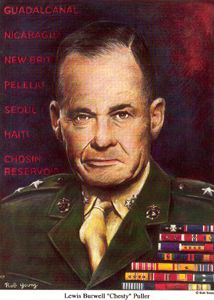
Lewis B. ‘Chesty’ Puller: Iconic Marine Corps Leader
Are Sage Commanders Born or Made?
Sometimes, when I start thinking about leadership and what it takes to be a great leader, it leads me to the question of whether sage commanders on the battlefield are born or nurtured. History is filled with great commanders and leaders. The question always lingers — are they born with those abilities, or are they forged through experience?
In my experience, leadership is a learned skill. There are limits to each person’s ability to become a leader, but at the end of the day, everyone leads to some level or another.
There are many traits to becoming a great leader, but perhaps the most important is the commitment to lifelong learning. Lieutenant General Harold G. “Hal” Moore exemplified this principle. Throughout his career, Moore studied military history and leaders, applying lessons from past campaigns to his own commands.¹ Admiral Hyman G. Rickover, often called the “Father of the Nuclear Navy,” demonstrated another dimension of intellectual leadership by mastering the technical aspects of nuclear propulsion and pushing the Navy into a new technological era.²
Sage commanders also inspire their subordinates to follow them through hardship and to strive for excellence. Lieutenant General Lewis “Chesty” Puller stands as one of the most revered figures in Marine Corps history.³ Puller led from the front, cared for his Marines, and embodied the fighting spirit of the Corps through the brutal campaigns at Guadalcanal, Peleliu, and the Chosin Reservoir.⁴
Another trait of wise leaders is their ability to build relationships. General Dwight D. Eisenhower exemplified this in his role as Supreme Allied Commander during World War II.⁵ Eisenhower’s diplomatic skill in managing powerful personalities like George S. Patton and Bernard Montgomery helped maintain the fragile Allied coalition focused on the goal of defeating Nazi Germany.
Integrity and moral courage are essential traits as well. Eisenhower demonstrated both when he accepted full responsibility for the potential failure of Operation Overlord, drafting a note to that effect before D-Day — a document he never had to release, but which speaks volumes about his character.⁶
Sage leaders also study their craft and their opponents. Hal Moore, before his historic stand in the Ia Drang Valley in 1965, walked the site of the French disaster at Route 1 between Hue and Quang Tri to understand his enemy and terrain.⁷ His study and respect for his adversary gave him insight that helped him anticipate and counter a numerically superior force.
These skills were all learned. In my fifty years on this planet, I have seen too many examples of poor leadership — leaders who refused to adapt, who clung to “that’s how it’s always been done.” I have learned my own leadership lessons the hard way — through failure. To improve my skills, I study the writings and lives of great leaders. I try to follow Puller’s example by leading from the front, and Hal Moore’s by studying relentlessly.
At the end of the day, however, the Japanese industrialist Taiichi Ohno said it best: *“Learn by doing.”*⁸
Footnotes
- Harold G. Moore and Joseph L. Galloway, We Were Soldiers Once… and Young (New York: Random House, 1992), 31–33.
- Theodore Rockwell, The Rickover Effect: How One Man Made a Difference (Annapolis: Naval Institute Press, 1992), 57–61.
- Jon T. Hoffman, Chesty: The Story of Lieutenant General Lewis B. Puller, USMC (New York: Random House, 2001), 144–46.
- Allan R. Millett, Semper Fidelis: The History of the United States Marine Corps, rev. ed. (New York: Free Press, 1991), 511–14.
- Stephen E. Ambrose, Eisenhower: Soldier and President (New York: Simon & Schuster, 1990), 201–05.
- Ambrose, Eisenhower: Soldier and President, 314.
- Moore and Galloway, We Were Soldiers Once… and Young, 45–46.
- Jeffrey K. Liker, The Toyota Way: 14 Management Principles from the World’s Greatest Manufacturer (New York: McGraw-Hill, 2004), 10.
Bibliography
Ambrose, Stephen E. Eisenhower: Soldier and President. New York: Simon & Schuster, 1990.
Boutelle, Steven W. The Art of Command: Military Leadership from George Washington to Colin Powell. Edited by Harry S. Laver and Jeffrey J. Matthews. Lexington: University Press of Kentucky, 2008.
Hoffman, Jon T. Chesty: The Story of Lieutenant General Lewis B. Puller, USMC. New York: Random House, 2001.
Liker, Jeffrey K. The Toyota Way: 14 Management Principles from the World’s Greatest Manufacturer. New York: McGraw-Hill, 2004.
Millett, Allan R. Semper Fidelis: The History of the United States Marine Corps. Rev. ed. New York: Free Press, 1991.
Moore, Harold G., and Joseph L. Galloway. We Were Soldiers Once… and Young. New York: Random House, 1992.
Rockwell, Theodore. The Rickover Effect: How One Man Made a Difference. Annapolis: Naval Institute Press, 1992.
Originally published at the live site .