
Could the Allies Have Prevented the Fall of France and Poland?
France had better tanks, a comparable air force, and a fortified line. They lost anyway. A short reckoning with leadership, doctrine, and the Maginot delusion.
By The Captain
Blitzkrieg.
Looking at World War II, I wanted to share some thoughts on whether the Allies could have prevented the fall of Poland and France. People often wonder why Germany’s rapid advances in Poland and France at the beginning of the war weren’t stopped — here is the Captain’s take.
This question is a hard one to answer and would require many assumptions. Before we answer it though, we need to look at what happened. The Allies were not wanting to fight another destructive war. This lack of will to fight opened the door for Hitler and his regime to start one. They watched as he managed to take Austria and Czechoslovakia without a fight, but when he invaded Poland under false pretense, they finally realized that he was not going to stop. So England and France went to war.
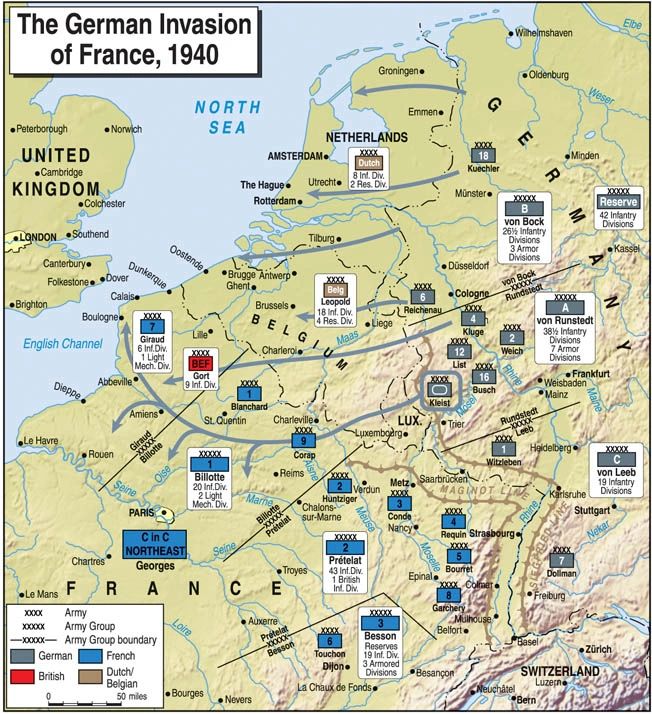
France, dreading another protracted and destructive war with Germany, decided on a system of fixed defensive positions that was known as the Maginot Line, which stretched from Switzerland to the beginning of Belgium’s border with France. Due to treaty issues, they could not extend the line along Belgium’s border, which weakened the fixed defenses. In the words of William Shirer:
“The trouble with the Maginot Line was that it was in the wrong place. The classical invasion route to France which the Germans had taken for nearly two millennia, since the earliest tribal days, lay through Belgium. This was the shortest way and the easiest, for it lay through level land with few rivers of any consequence to cross.”
French armor was superior to their German counterparts as well in 1940. German Mark I, II, and III tanks that they invaded France with in 1940 were no match to the heavily armored French Char B1 tank. German tanks and 37mm anti-tank guns could not pierce its armor, and the Char’s 75mm gun outranged the German tanks as well. Of course, the French tank had design weaknesses such as the 75mm gun being fixed, so the whole machine had to be turned to target the weapon.
German airpower was also roughly equal. Compared to Britain’s Supermarine Spitfire, the Bf 109 was pretty equally matched. The Germans had, however, had the time to perfect close air support, where their combined arms tactics were well rehearsed and their army and air force had the experience coming into this battle. The French did not have the tactics for using their armor and air force in a maneuver warfare environment, as all of their faith was placed in the Maginot Line.
Finally, French leadership did not have the will or competency to defend against what the Germans had in store when they invaded in 1940. The German Blitzkrieg was predicated on lightning-fast movement meant to destroy the enemy before they could react — by breaking through, surrounding the defenders, and crushing them. The French as well as the British were not prepared for this. Because of this, Churchill wisely limited the Royal Air Force’s use in France and wisely evacuated the British Expeditionary Force to keep it from being annihilated.
So in answer to the stated question, there is no way that they could have stopped the defeat of France with the leadership and the tools that they had. Had France had stronger military leadership that wasn’t trying to refight the First World War, maybe. That unfortunately was not the case, and Churchill recognized that fact and wisely preserved the British Army and Air Force for the fight to come.
Endnotes
- Flint Whitlock. “The French Maginot Line: Its Full History and Legacy after WWII.” Warfare History Network, March 2002.
- “B1 bis production from July 1937 to June 1940.” Arquus.
Bibliography
Carlin, David. “World War II: How Western Leaders Failed To Stop the Nazi Rise.” Forbes, 10 December 2021.
Hanson, Victor Davis. The Second World Wars. New York: Hachette Books, 2017.
Shuster, Richard J. “The Allied Disaster in France and the Low Countries, 1940.” Marine Corps University.
Whitlock, Flint. “The French Maginot Line: Its Full History and Legacy after WWII.” History Warfare Network, March 2002.
Originally published at the live site .