Guadalcanal: What Japan Could Have Done to Win
After Savo Island, the Japanese had the Marines isolated and beachable. They squandered it. A look at why the Solomons turned the tide of the Pacific.
By The Captain
This week, I am going to attempt to tackle the question: “What could the Japanese have done to stop the Americans in the Guadalcanal Campaign?” Guadalcanal was the most significant battle in the Pacific because it put the Japanese on the defensive for the rest of the war. It would be a 7-month struggle costing both sides dearly in life and treasure.
The Facts
Americans in 1942 had never heard of the Solomon Islands, let alone been able to point to them on the map. Reeling from the rapid losses to the Japanese since December of 1941, Americans needed some wins. These would come in the Spring of 1942 with wins in the Coral Sea and Midway. These naval wins were key, but the Japanese behemoth needed to be pushed back to their island nation, and the only way to do that was to take back the property they conquered.
The Pacific theater would be where the Marines would showcase their art in amphibious warfare and solidify their place in the American armed forces. Their first success would be in the Solomons on the jungle-covered islands of Guadalcanal, Florida, and Tulagi. The fight would last for 7 months and in this first meeting of Japanese and Americans on the battlefield would set the tone for the Pacific Theater and set it apart from the other theaters of the war.
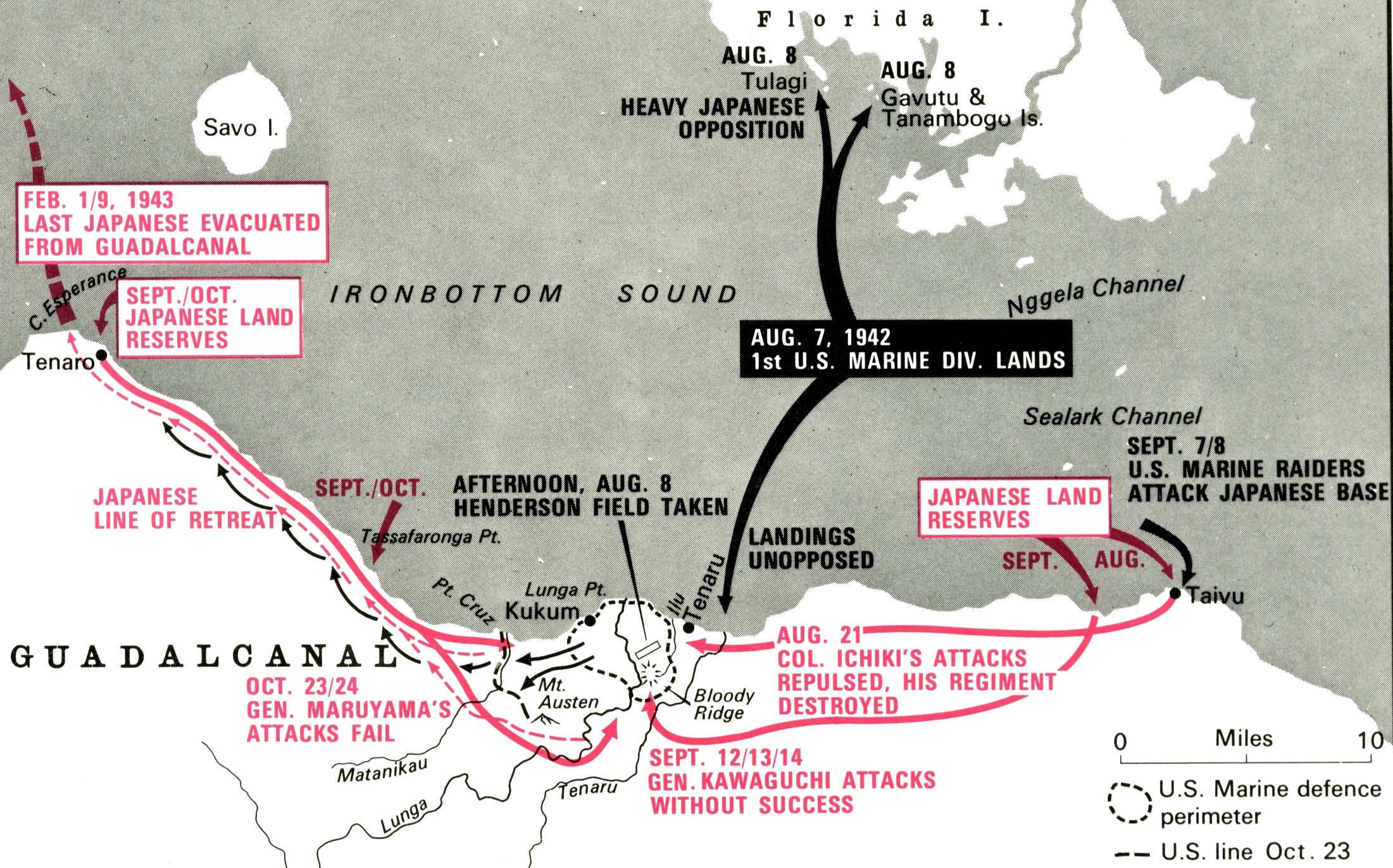
In July 1942, Japanese forces landed on Guadalcanal and began fortifying a small section of the island and laying down an airfield. An American reconnaissance flight overflew the island and took some surveillance photos, alerting the Americans and Australians to the problem. This base would allow the Japanese the ability to perform airstrikes into Australia as well as provide a staging base to further disrupt the Allied communications and supply routes. Both General MacArthur and Admiral Nimitz knew this and immediately planned an amphibious operation.
On the 7th of August, 1942, American Marines of the 1st Division led by Major General Alexander Vandegrift, supported by Admiral Jack Fletcher’s fleet, made an unopposed landing on Guadalcanal. The same was not true on Tulagi, where the Marine Raiders under Colonel Edson fought a hard-won battle against the Japanese defenders. By the end of the first week, the Marines had secured and set up defenses on both locations. Multiple battles on both land and sea raged through August, September, and October. The Navy would face its worst defeat in history during the Battle of Savo Island, but eventually gained control of the sea lanes and resupplied the beleaguered and battered Marines on the island. The Marines, undersupplied and sick from the exotic jungle maladies such as malaria and dengue fever, fought brave defensive battles against the Japanese human wave attacks known as Banzai charges.
The Japanese were not willing to give up the island without a fight. They continuously resupplied and reinforced their troops on Guadalcanal. They made many attempts to retake the airfield, which became known as Henderson Field (after a Marine pilot that died at Midway). They also continuously bombed the airfield with bombers from Rabaul and shelled it from cruisers that would race down the waterway from Rabaul known as “the Slot.” This would continue until the U.S. Navy smashed their reinforcement convoy carrying 10,000 reinforcements. As a result, only 4,000 would reach the beach, and that would be their last attempt at reinforcing their position. By October, the U.S. Army’s 164th Infantry Division joined the fight, relieving the beat-up 1st Marine Division. By the 7th of February 1943, the Japanese evacuated the island, giving the Americans their first victory in the Pacific.
Analysis
Guadalcanal for the Americans was a vital strategic and psychological victory. It provided the first step into what would become known as island hopping and provided a vital airbase to project air power against the formidable Japanese defenses. For the Japanese, they learned that American tenacity and ability to fight was not what they expected it to be, and found that American logistical might was superior. The losses for Japan in men, ships, and aircraft would be felt as they could not replace them as fast as American industrial might could. It also ended their advances and put them on defense the rest of the war.
To answer the question, Guadalcanal was really the only place that they could have been victorious against the Americans. They failed to take advantage of their naval win at Savo Island on 9–10 August. This was the vital time they had to blockade the Marines on the beach and reinforce their units on the island. They needed to smash the Marine defenses and overwhelm the force that was stranded there without resupply or naval support while they had the chance. They squandered this opportunity and could never again regain the initiative.
The Japanese were fierce fighters following an archaic code that was the primary cause of their failure. Their repeated banzai charges, though at times broke into the Marine lines, would waste thousands of lives. They did not have a strong NCO corps that could lead small units, and their disdain for retreat pushed them to their failure. They also underestimated the American resolve and fighting spirit, which was as high as their own. Even in the hardest situations in the early days of the campaign, American morale never faltered.
Bibliography
“The Solomon Islands Campaign: Guadalcanal.” The National WWII Museum, New Orleans.
“Naval Battle of Guadalcanal.” Naval History and Heritage Command, 25 June 2024.
Guadalcanal | U.S. Army Center of Military History.
Groom, Winston. 1942: The Year That Tried Men’s Souls.
Originally published at the live site .