American Civil War · 1863 ·
The Siege of Vicksburg
Grant's 1863 siege split the Confederacy in two and secured the Mississippi for the Union — a master class in joint operations, logistics, and adaptive leadership.
- Outcome
- Decisive
- Belligerents
- Union vs. Confederacy
- Commanders
- Ulysses S. Grant · John C. Pemberton · David Dixon Porter
Introduction
“Vicksburg is the key; the war can never be brought to a close until that key is in our pocket.”[1] Lincoln’s statement captures the strategic importance of this Mississippi city perched in the bluffs overlooking the river. The siege of Vicksburg, fought from 18 May until 4 July 1863, was the culmination of a campaign to regain control of the Mississippi river, which was the superhighway of nineteenth century America. The outcome would showcase the decisive power and importance of joint operations, the critical role of logistics, and the necessity of bold strategic vision. The fight pitted Union General Ulysses S. Grant and Confederate Lieutenant General John C. Pemberton in what became the most decisive struggle of the war as the fall of Vicksburg split the Confederacy in two and secured the “Father of Waters” for the Union.
Strategic and Operational Overview
The Mississippi River was the central artery of North America. The river was a superhighway for trade, supply, and military movement. Control of the river lay at the heart of the strategy to defeat the South. To emphasize the importance of the river Lincoln wrote “The Father of Waters again goes unvexed to the sea” celebrating Vicksburg’s eventual fall as a fulfillment of national destiny.[2] Winnfield Scott’s original strategy to defeat the Confederacy, dubbed the Anaconda Plan, envisioned choking out the south by cutting it off from trade and resources. This would be achieved through naval blockade of ports and taking control of the Mississippi river, cutting the Confederate states in two. The Confederacy recognized this and built Vicksburg into a fortress city to protect communication and supply between the East and West portions of the Confederacy.
Early Attempts
Union planners knew the strategic importance of the Mississippi river and that Vicksburg was a key strategic point. Following his success in taking New Orleans in April 1862, Admiral Farragut sailed his blue water fleet up the river and demanded the city’s surrender. Confederate defenders, perched high among the bluffs, refused. Farragut began bombarding Vicksburg in June and July, both times ineffective against the Confederate positions. The steep terrain rendered naval gunfire nearly useless and supporting infantry could not mount a successful assault.[3] A second attempt was made with a concerted effort to have supporting troops move south from Memphis, but it also failed. These failures revealed the hard truth that Vicksburg could not be taken by naval power alone. It required tight coordination between land and naval forces to achieve victory, which Grant was to give a master class in.
Area of Operations
Sitting atop of commanding bluffs with steep ravines and heavy vegetation, Vicksburg was a natural fortress. Confederate engineers used the terrain to expertly build a line of forts, trenchworks, and redoubts about the city. The Mississippi River’s winding path created bayous, swamps, and a generally impossible approach from the West but did help in concealing some Union movements during the siege. The unpredictable currents, whirlpools, and heavy currents also complicated river crossings and only the flat-bottomed boats could successfully navigate the rivers if experienced pilots were aboard. On top of all that, Mississippi’s brutal climate added another layer of hardship in the form of heat prostration, disease, and all of the other sufferings found in the Mississippi delta and Louisiana swamps.[4]
Opposing Forces
The Union army started the siege at 77,000 troops and were well supplied thanks to the secured river routes. The U.S. Navy under Admiral David Dixon Porter played a key role during the siege by bombarding Confederate positions and the city itself continuously and ferrying supplies. The Confederate defenders only had 33,000 troops and were ill supplied and cut off by the Union. By the end of the siege, their rations were reduced to mule meat, peas, and even rats became staples.[5] One Confederate soldier wrote in June 1863, “We are eating mule meat, and thankful even for that. Hunger is an awful master.”[6] Civilians, equally tormented, took to living in caves due to the continuous shelling of the city. One Confederate woman would write in her diary, “We live in caves…the shelling is awful, but we are safe.”[7] Emma Balfour, a Vicksburg resident writes, “The shelling is awful. All are living in caves. Our only thought is to escape death or wounds.”[8]
Leadership
The campaign’s outcome hinged upon leadership. Grant demonstrated flexibility, adaptation, and quickly went from failed frontal assaults to a systematic siege. His coordination and cooperation with Porter underscored his ability to integrate and perform joint operations. Pemberton, by contrast, suffered from divided loyalties and political pressure. A Pennsylvanian by birth, Pemberton was distrusted by Confederate leaders, though he was appointed by Jefferson Davis himself. He was ordered to “hold Vicksburg at all costs.” This rigid order limited his options and ultimately condemned his army to entrapment.[9]
The Action
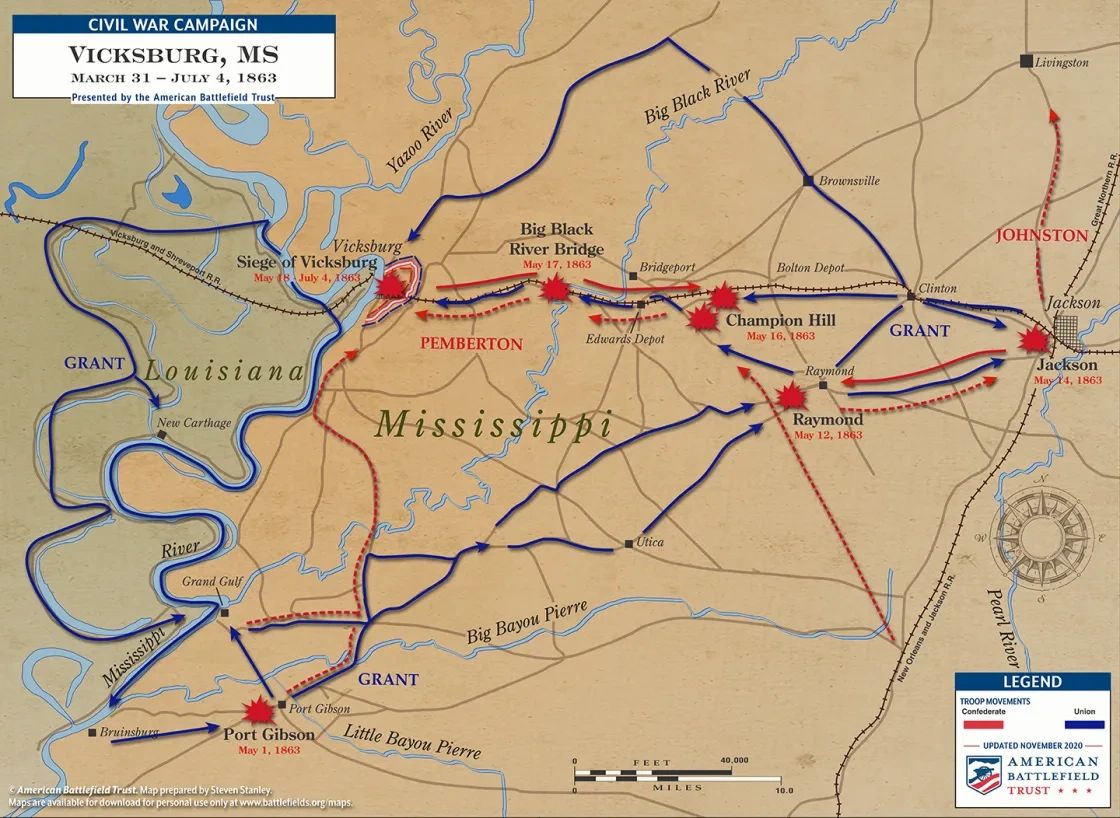
See also: American Battlefield Trust — Vicksburg Campaign Maps
Opening Moves
After securing the crossings of the Mississippi, taking Jackson, defeating the Confederates at Champion Hill and the Big Black River by mid-May 1863, Grant drove Pemberton’s army into defensive positions around the city. On 19 May 1863, an overconfident Grant began frontal assaults on the positions, figuring that the city could be taken quickly. He was wrong. The steep bluffs and fortified Confederate positions proved impenetrable. A second assault on 22 May, with massed artillery support, also failed with resulting heavy casualties. A soldier from the 21st Iowa grimly noted, “our men went up like a storm, but they came down like rain.”[10] These bloody assaults convinced Grant that the city could not be stormed by direct attack and that siege operations must commence.
Siege Operations
Beginning in late May, Union engineers and soldiers dug a network of trench lines that gradually closed in on the Confederate lines. In a foreshadowing of the First World War, sappers tunneled under forts and filled them with explosives, artillery pounded the lines and city continuously from the surrounding hills and river.
Inside Vicksburg, conditions deteriorated rapidly. Civilians sought shelter in caves dug into the hill sides, enduring the constant shelling. Emma Balfour writes in her diary, “Night and day the shells are screaming, bursting, tearing their way through the air. God only knows who will be the next victim.”[11] Some, like Duff Green, who was a prominent citizen in Vicksburg, converted his mansion into a hospital, filling it with wounded from both sides. To shield his family and property from destruction, Green placed Union Soldiers on the top floor. This ensured that Union artillery would no longer target the house, which had already been struck by five cannon balls, one of which remains stuck in the ceiling to this day of the Pemberton room of the house. Green later recalled, “By making my home a hospital, and placing the Yankees above, I saved it from ruin. Shells passed over, but not one struck.”[12]
The psychological pressure was as devastating as the physical. Union troops, well supplied and confident, kept up relentless pressure on the Confederate defenses. One Illinois soldier recalled, “We never let them rest, if they were not shelled, they were mined, and if not mined, we pushed our trenches closer. They could see the end coming.”[13]
Collapse and Surrender
By late June, Confederate forces and civilians alike were exhausted, malnourished, and unable to hold their lines much longer. As Grant prepared his final assault, Pemberton received a letter on 3 July, anonymously slid under his door of his headquarters at the Willis-Cowan house that read, “If you can’t feed us, you had better surrender. Worse than savage is to starve us here.”[14] This blunt appeal from his men reflected their desperation and confirmed what Pemberton already knew — the defense of Vicksburg was at its end.
On the morning of 4 July 1863, one day after Lee’s defeat at Gettysburg, Pemberton surrendered the city. Per usual Grant insisted on unconditional surrender, but allowed the parole of the 29,000 Confederate soldiers, becoming the largest capitulation of a Confederate army during the war.[15]
Grant’s decision to parole the Confederates instead of sending them to Union prison camps was both pragmatic and magnanimous. By allowing these beaten soldiers to return home under the promise of not rejoining the Confederate army saved the Union the burden of feeding thousands of prisoners and reduced resentment amongst the defeated.
The Significance
Immediate Outcome
The fall of Vicksburg was catastrophic for the Confederacy. By surrendering on 4 July 1863, Pemberton lost 29,000 troops.[16] The city itself was gone, ceding control of the Mississippi river to the Union and dividing the Confederacy in two as well as choking off supplies of cattle, grain, and manpower from the now isolated Texas, Louisiana and Arkansas.[17]
Strategic Turning Point
The victory at Vicksburg came one day after the Union triumph at Gettysburg and is often overshadowed by it. Together, these two victories in early July 1863 marked the high-water mark of Confederate fortunes. Historian James McPherson has called the capture of Vicksburg “the fulfillment of the Anaconda Plan,” noting that the Union accomplished its long term goal of controlling the strategically important Mississippi river.[18] President Lincoln captured the national meaning of Vicksburg’s fall when he declared, “The Father of Waters again goes unvexed to the sea.”[19] This was not mere rhetoric. With the river open, Union armies had freedom of navigation to move supplies and troops, reducing the South’s ability to continue the war.
Lessons Learned
- Logistics were decisive. Union forces resupplied by the Navy remained well fed and equipped. Confederates, choked off from supply and aid, faltered.
- Joint operations were essential. Porter and Grant’s strong relationship created good coordination and effectively demonstrated the use of joint forces.
- Leadership and adaptability were key. Grant’s recognition that the frontal assault was a failure and his shift to siege tactics exemplified flexibility and adaptation is key to winning battles.
- Morale and will to fight mattered. Grant targeted these during the siege as much as the enemy positions. His constant shelling of the city and ability to prevent Confederate resupply played as much of a part as the actual actions. This would erode the Confederate resolve and lead to its surrender.
Broader Meaning
Vicksburg was more than an operational and tactical victory; it was also a psychological and political win. For the North, it was proof that the Union War effort was succeeding. For the South, it was a devastating blow to their morale and war effort, and when combined with Gettysburg, the turning point of the war. As Frederick Douglas would later observe, victories like Vicksburg proved that emancipation and Union were inseparable causes as black troops who fought for the Union helped secure both.[20]
Conclusion
Abraham Lincoln had called Vicksburg “the key” and its capture proved him correct. From May–July 1863, Grant’s army and Porter’s navy combined persistence, ingenuity, and overwhelming pressure to force one of the Confederacy’s strongest and most vital positions. The siege demonstrated the role of logistics, adaptive leadership, and coordinated joint operations. It also revealed the human dimension of war on both soldiers and civilians. Homes were turned to hospitals, soldiers and civilians reduced to starvation and privation, and general desperation illustrated in a single note begging for surrender.
The fall of Vicksburg split the Confederacy in two, secured the Mississippi River for the Union, and paired with the win at Gettysburg, was the turning point in the war between the states. The victory was celebrated by Lincoln as a strategic triumph and the signal that the Union’s ultimate victory was at hand.
As a final note of interest, though the celebration and fireworks display are among the greatest in Mississippi, Independence Day was not celebrated in Vicksburg until 1957, when Eisenhower came to town. Instead, it was treated as a day of mourning.[21]
Originally published at the live site .