
Queen Anne's War (War of the Spanish Succession) · 1702 ·
The Siege of Castillo de San Marcos
In 1702, Carolina's James Moore tried to take Spanish St. Augustine and the coquina-walled Castillo de San Marcos. The walls absorbed everything he threw at them — and two Spanish warships finished the story.
- Outcome
- Tactical
- Belligerents
- Spain vs. England (Carolina colony)
- Commanders
- Don Joseph de Zúñiga y Zérda · James Moore · Robert Daniel
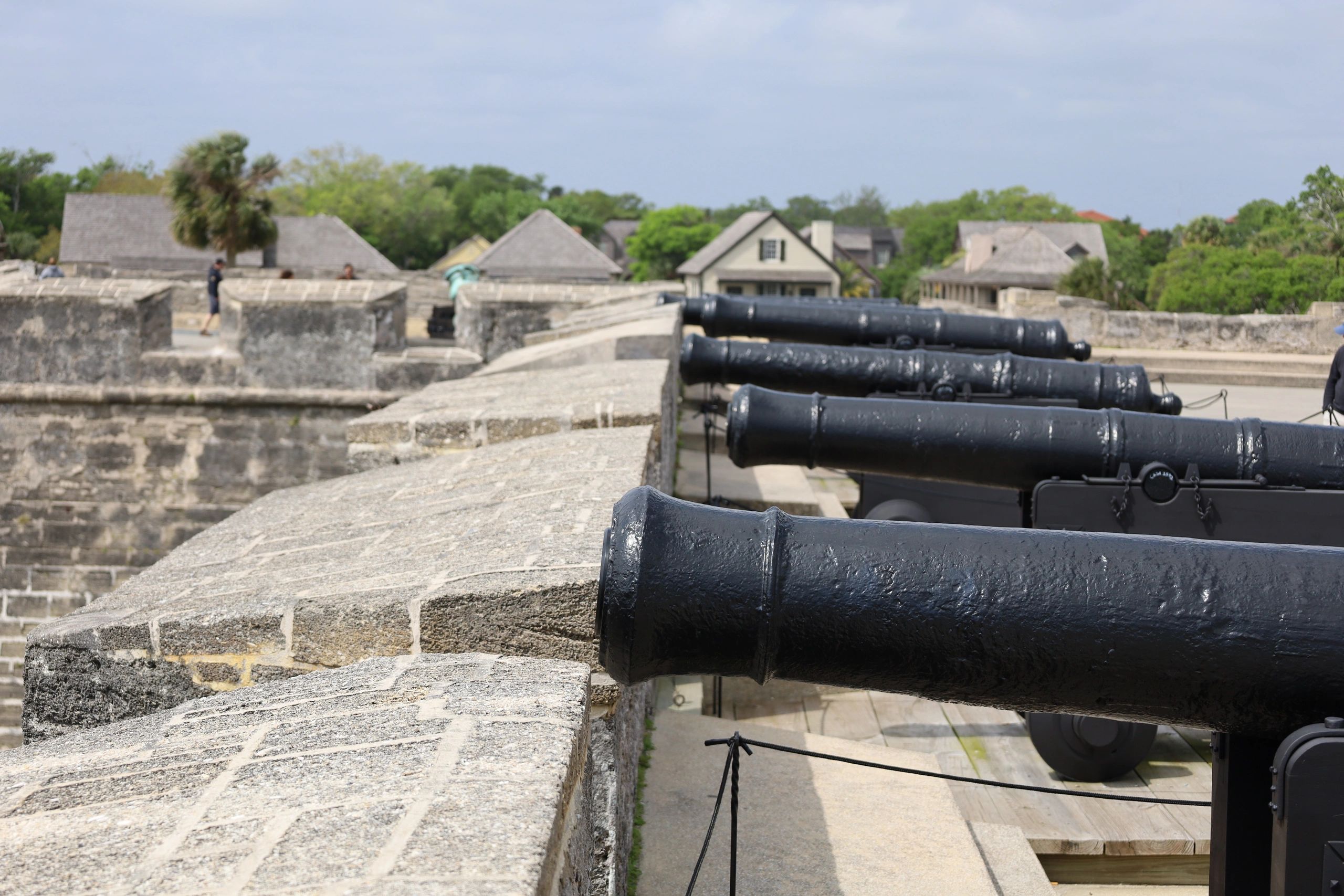
A few months ago, The Captain and Krewe paid a visit to America’s oldest city of St. Augustine. Overlooking the waterfront sits the Castillo de San Marcos, an imposing figure that was the height of the era’s defensive technologies. This was the start of a deeper dive into the fort’s history. Here is the story of the first siege of Castillo de San Marcos.
Strategic Setting
The King of Spain, Charles II, died in 1700 without an heir to succeed him. Before he died, with the coaxing of King Louis XIV, Charles appointed Philip d’Anjou as his heir, who was Louis XIV’s grandson. This move made a strong alliance between Spain and France, which England saw as a major problem. Seeing this move by Spain and France, King William III of England began building an alliance with the Netherlands, Prussia, many of the German states, and Austria. This alliance was strongly opposed to Philip d’Anjou succeeding to the Spanish throne. This was due to the strength France would gain having Spain as a close ally.
On 1 November 1700, Charles II died. Once Spain and France moved to put Philip d’Anjou on the Spanish throne, Queen Anne, who succeeded William III upon his death, got the allies together and went to war in 1701. This would become known as the War of the Spanish Succession or Queen Anne’s War and would rage across Europe and the New World for 11 years. In the New World, we will see the Carolinians launch an attack against Spanish Florida in an effort to try and take Castillo de San Marcos, located in St. Augustine.
The Fortress
Castillo de San Marcos, in 1702, was a modern fortress for the time. The walls are 30 ft in height and 14 feet thick. They were constructed of a limestone and seashell mixture known as coquina. And with lessons learned in the age of cannon, its four corners have the angled bastions giving it a star look. This design improved the strength of the walls against cannon fire. These defenses would soon be tested.
Opposing Forces
James Moore was the governor of the Carolinas at the time. A wealthy plantation owner and slave dealer, Governor Moore was considered an ambitious man. He had the foresight to see the coming war in 1700 and began to lay the groundwork for a campaign against Spanish Florida and the Castillo de San Marcos. At first, the Carolina Commons (Legislature of the period) were against it, but once war was declared, they fully supported Governor Moore and made him the commander in chief of the campaign forces, though he had no experience in the combat arts. They raised an army that was a mix of white men, slaves, and Indians from different tribes. He would split his force and advance on the Spanish in 2 prongs.
The first prong would be a land force and the second would be an amphibious force that would arrive from the sea. There are conflicting accounts of the actual size of the force. In his after-action report to the King of Spain, Don Joseph de Zúñiga y Zérda learned from captured prisoners that the invading force arrived with a naval force of various ships carrying 400 soldiers and 80 sailors. The land force comprised 500 men, totaling 900, though other accounts go as high as 1,200. Along with this company went cannon and the other equipment needed to lay siege and assault a fortress.
The Spanish forces were led by Don Joseph de Zúñiga y Zérda, and his defenders numbered 154 soldiers and 42 militia. Upon receiving intelligence that the Carolinians were on the march, he brought the inhabitants of St. Augustine — including clergy — into the Castillo de San Marcos. He also ordered cattle, corn, and other sundries brought within the walls. The inhabitants numbered 1,500 and he was able to get another 60–70 able fighters to add to his ranks. He also managed to maintain 32 horses he used to run messages to his commanders afield in Pensacola and Apalachee. Zúñiga would also ask for reinforcements from Pensacola and Havana.
The Siege
Moore and his 13 ships arrived in St. Augustine on 8 November 1702 and set up a blockade. Two days later, the land forces arrived under the command of Colonel Robert Daniel, who managed to destroy several Spanish outposts as well as securing other outposts while his crew marched south. Once Colonel Daniel arrived, Moore set about disembarking troops at St. Augustine and set about conquering the town. The soldiers were shocked to find such a rich city and that it was totally empty. They would also find that Zúñiga ordered the houses and buildings closest to the fort burned so as to give clear fields of fire for their cannon as well as deny the Carolinians the advantage of cover and housing.
It would take until 16 November for the Carolinians to set their siege in place, but due to lack of competent leadership or experience, they left access to the west gate of Castillo de San Marcos open and Zúñiga was able to continue sending messengers. He also received a small detachment of men under the command of Captain Francisco Romo de Uriza on the morning of the 16th. Zúñiga would send a patrol on 22 November and they would return with two prisoners from whom Zúñiga would gain some valuable information of the forces arrayed against him.
As the Carolinians set about their siege, they realized they did not bring enough artillery, so Moore dispatched Colonel Daniel to secure “men, bombs, and bigger guns.” While Daniel would embark on his mission, the Carolinians continued working on their siege fortifications and had to fire a few more buildings so that their cannon could fire on the fort. They would trade shots occasionally with the Spanish, but nothing sustained. They also found that the artillery they did have was insufficient for the task, as the coquina that made up the walls absorbed the impact with little damage.
With the ability to still move in and out of his fortress, Zúñiga would send out small bands of men to engage in hit-and-run attacks on the Carolinian boats as they lay at anchor. He also continued sending messengers with pleas for assistance. The morale inside the fortress of the people was one of uncertainty. They did not know if they would get the help they were hoping for.
The siege would drag on with combat at varying levels of intensity. Moore would receive his long-awaited guns and reinforcements on Christmas Eve. Morale inside the Spanish defenses dropped further until 26 December, when 2 Spanish warships entered the river. With the arrival of the warships, the disembarkation of reinforcements, and the lack of progress, Moore ordered a withdrawal of the Carolinian forces on 29 January 1703. On their way out they fired what remained of St. Augustine and made their way back to Charleston in defeat.
Aftermath
The campaign cost Carolina £8,495, which was significantly more than the £2,000 allotted for the adventure. Governor Moore would lose his position as governor but would manage to remain a player in Carolina politics. Zúñiga would gain standing among his fellow Spaniards due to his victory over the Carolinians. However, this is often considered a hollow victory as the Castillo de San Marcos still stood strong but St. Augustine was destroyed. This battle would also be considered the first battle in a century of war in North America.
Bibliography
Arnade, Charles W. The Siege of St. Augustine in 1702. Gainesville: University of Florida Press, 1959.
Boyd, Mark F. “The Expedition of General James Moore Against St. Augustine in 1702.” Florida Historical Quarterly 16, no. 3 (January 1938): 131–172.
Castillo de San Marcos National Monument. National Park Service.
Crouch, Dora P. Castillo de San Marcos: Guardian of the Spanish Empire in the New World. Washington, D.C.: U.S. Department of the Interior, National Park Service, 2002.
Gallay, Alan. The Indian Slave Trade: The Rise of the English Empire in the American South, 1670–1717. New Haven: Yale University Press, 2002.
Hoffman, Paul E. Florida’s Frontiers. Bloomington: Indiana University Press, 2002.
Johnson, Sherry. The Spanish Empire in the Americas. New York: Oxford University Press, 2017.
Landers, Jane. Colonial Plantations and Economy in Florida. Gainesville: University Press of Florida, 2000.
Manucy, Albert. The Building of Castillo de San Marcos. Washington, D.C.: U.S. Department of the Interior, National Park Service, 1967.
Moore, James. “Account of the Siege of St. Augustine, 1702.” In Colonial Records of South Carolina: The Governor’s Correspondence, edited by A.S. Salley Jr. Columbia: Historical Commission of South Carolina.
Originally published at the live site .