Vietnam War · 1968 ·
The Battle of Hue: Another Example of USMC Tenacity
In January–March 1968, U.S. Marines and ARVN forces clawed back the ancient imperial capital from the NVA in the largest and bloodiest urban battle of the Vietnam War.
- Outcome
- Tactical
- Belligerents
- United States vs. Republic of Vietnam (ARVN) vs. North Vietnam (NVA) vs. Viet Cong
- Commanders
- Ngo Quang Truong · Marcus J. Gravel · Ernest C. Cheatham · Stanley Hughes
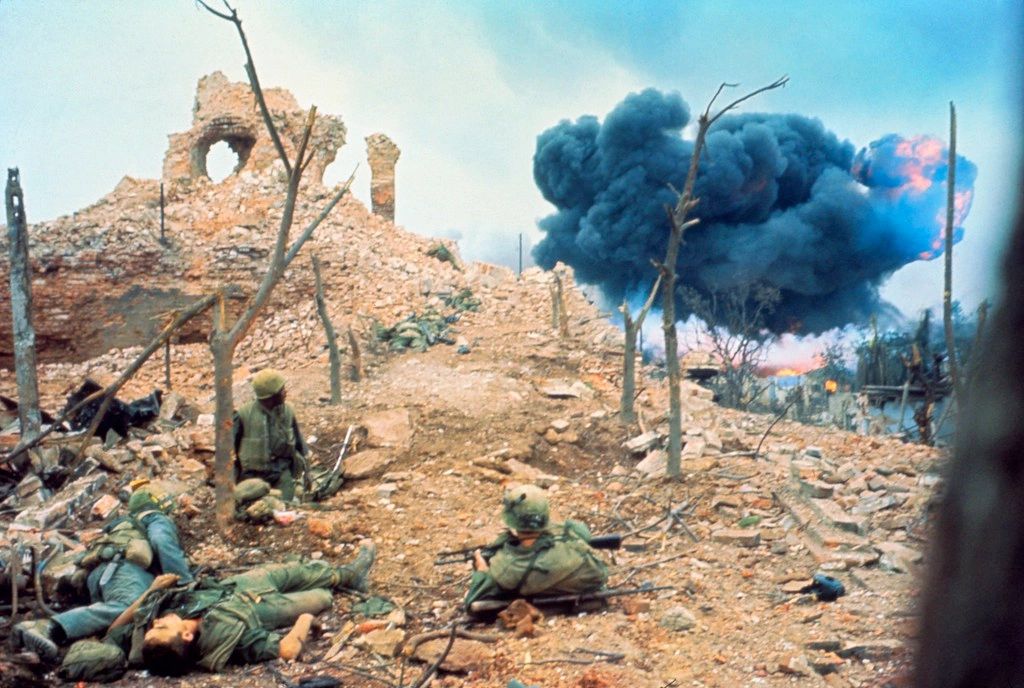
On the website for the 1st Battalion, 6th Marines, they have a quote from General Pershing in World War I after seeing the Marines in action. The quote reads, “The deadliest weapon in the world is a Marine and his rifle.”[i] Marines have proven time and again that they are ferocious fighters and will not quit until the battle is won. The fight for Hue City in 1968 is one such battle.
In the pre-dawn hours, four men dressed in ARVN (Army of the Republic of Vietnam) uniforms approached the West Gate of the Citadel, in Hue City. The ARVN guards at the gate, taken by surprise, were quietly killed and the gates opened for the 4th NVA (North Vietnamese Army) and their VC (Viet Cong) support elements to enter the walled Citadel and begin their assault upon Hue City. At the same time, another Sapper team assaulted the 7th ARVN Cavalry unit a short distance away, destroying 11 M41 Light Tanks. These were the opening shots that would become the most intense urban battle of the Vietnam War.
On the 31st of January 1968, the attack on this ancient provincial capital of the Thua Thien province was just one of the 100 targets attacked across Vietnam during what was supposed to be the Tet Holiday where a cease-fire had been agreed to. So much for a holiday that “carries love and hope; signifies family and friend kinship; and promises a better year ahead.”[ii] Ho Chi Minh and Vo Nguyen Giap gambled on a major offensive that had two stated goals: cause the South Vietnamese people to revolt against their government, and bring South Vietnam and America to the peace table. After months of moving men and materials into position, they began what became known as the Tet Offensive on 30 January 1968.
Strategic Setting
Hue City, the third largest city in Vietnam, had been largely untouched by the war. Straddling a bend in the Perfume River (Song Huong), the city commanded an important strategic point. Hue was an important junction of Highway 1 and the railroad as well as a major naval supply point. In fact, General Westmoreland told President Lyndon B. Johnson in a meeting in 1966 that the capture of Hue “would have profound psychological impact on the Vietnamese in both the North and the South, and in the process the North Vietnamese might seize the two northern provinces as bargaining points in any negotiations.”[iii]
The Perfume River divided the city into two parts. To the North of the river was considered the Old City, built in the early 19th century, and held the Citadel. Built along the design of the Forbidden City in China, the Citadel was an imposing fortress. Designed with 19th-century defense in depth in mind, the 20- to 30-foot-high stone walls encircled the city. These walls were 20 feet in depth. Before the walls lay a 75-foot-wide moat. Citadel access was controlled in and out of the fortress by gates. Inside the walls were buildings (mostly built of stone), gardens, canals, and markets. The Ta Loc airfield was also located inside. On the South Side of the fortress, overlooking the Perfume River, sat the Imperial Palace. It was another fortress surrounded by yet another wall. On the Northern side of the Citadel sat the 1st ARVN Divisional Headquarters, known as the Mang Ca compound.
South of the Perfume River sat the “New City.” It was designed after European and American cities and housed the Provincial Headquarters, government offices, the hospital, a prison, the University of Hue, and residential housing. Next to the Perfume River on the northeast side of the city sat the MACV Compound. Highway 1 came out of the south and crossed the river near the MACV compound into the old city.
Opposing Forces
Even though Westmoreland knew the significance of Hue, it was a lightly defended city. The MACV compound was staffed with mostly noncombatants and around 200 military staff and advisors. The ARVN 1st Divisional headquarters was manned by roughly 1,000 soldiers, mostly staff under the command of General Truong. The rest of the Division was stretched across the province. The closest regiment of the 1st ARVN Division was the 3rd Regiment. Also in the city at the time was a 36-troop recon platoon and the 240-man 802nd Battalion known as the Black Panthers, set as a quick reaction force. Outside the compound was the ARVN 7th Armored Cavalry Squadron with M113 Armored Personnel Carriers and one tank troop of M41 Bulldog light tanks.
15 km away, American units of Task Force X-Ray were stationed in Phu Bai. Task Force X-Ray consisted of the 1st and 2nd Battalions, 1st Marine Regiment; 1st Battalion, 5th Marines; and 1st Marine Tank Battalion with their M48A3 Gun Tanks, M67A3 Tanks, and M50 vehicles, as well as a Navy Support Detachment that operated Landing Craft. U.S. Army units of the 1st and 3rd Brigades, 1st Cavalry, and 2nd Brigade, 101st Airborne Division would also support the fight from Phu Bai and Quang Tri.
The 6th and 4th NVA Divisions were tasked with the Assault on Hue, along with 2 Sapper Battalions and an unknown number of Viet Cong fighters. In all 14 Battalions of infantry supported by a 122mm Rocket Battalion, 2 Companies each of 82mm Mortar, 75mm Recoilless, and 12.7mm Automatic weapons made their move.
The Opening Assault
The 6th NVA was assigned to the Citadel, Ta Loc Airfield, and the ARVN HQ Compound. The 4th NVA would make their assault on targets within the New City including Government buildings, the Radio Station, a hospital, the Prison, and the MACV Compound. The initial attacks in the early morning hours proved rapidly successful. The majority of the New City was quickly overrun. The only place that they found hard resistance was at the MACV Compound. In the Citadel, the NVA swept through but ran into heavy resistance at the Ta Loc Airfield which was held by the 802nd Black Panther Battalion. These fighters fought a pitched battle with small arms and light anti-tank weapons. After receiving some reinforcements from the HQ compound, they also proceeded to take back the medical billets near the airfield, but this victory would be short-lived as General Truong would recall them to the Mang Ca compound to reinforce his embattled forces. He would also recall the 3rd Regiment as well as 2 Airborne Battalions from nearby. With the support of the 7th Cavalry Squadron, using their M113s and M41s, they made the long bloody fight into the city. They would take heavy casualties, yet they arrived at the compound by noon. The NVA and VC would control 90% of the Citadel and most of the New City by the end of the afternoon. Only Mang Ca and MACV compounds held out.
Once the NVA and VC had control of the residential areas, special units rounded up people from a list of those considered to be “cruel tyrants and reactionary elements.”[iv] 3,000 people were arrested, interrogated, and ended up being executed. These people consisted of government officials, foreigners, Catholic clergy, and anyone deemed to be a Southern sympathizer.
The Marines Move In
MACV, Saigon, did not understand the significance and size of the assault. Gen. Westmoreland would report to the Joint Chiefs that Hue was under attack by 3 companies of NVA. In fact, it took 72 hours for them to even comprehend the scope of what was happening at Hue, let alone the whole country. Due to this initial lack of understanding, only one battalion was sent in to relieve the MACV and ARVN forces in Hue City. That job fell to 1st Battalion, 1st Marines under Lt. Col. Marcus J. Gravel. The Marines were trucked from Phu Bai up Highway 1 toward Hue. Elements of the NVA and VC ambushed them along the road, to which they had to dismount from the trucks and fight their way in. According to the after-action report, they arrived at the MACV compound by 2:45 PM on the 31st of January.
Once there, under protest, Lt. Col. Gravel was ordered to leave one company of Marines at the compound and to take the other company and relieve General Truong in the Citadel. The Marine M48A3 and M42 tanks were too heavy to traverse the bridge crossing the river and had to provide supporting fire from across the river. The 4 crews of the ARVN light tanks refused to lead the assault across the bridge, so Bravo Company made the assault under heavy small arms and automatic weapon fire. After hours of fighting, two platoons made it across the bridge only to have to give up the bridgehead a short time later, as the resistance was too heavy and the bridgehead untenable. This assault cost the Marines one-third of their force killed or wounded. At 8 PM both sides would stop fighting and move to regroup and consolidate forces.
Operation Hue City Begins
By the morning of 1 February 1968, as the situation on the ground became clearer, it was decided that for the time being, ARVN would be responsible for the Citadel while Task Force X-Ray focused on the New City. This would begin Operation Hue City. In the Citadel, General Truong was able to repel the attackers on the compound and make an assault on the Ta Loc airfield. By the end of the day, they would retake Ta Loc and set up a defensive perimeter.
On the south side, the Marines were already having problems. To begin with, they had not received any training in urban warfare or how to attack fortified positions. Secondly, they did not have maps of the area and used French-language road maps found at a gas station. Finally, the use of indirect fire and close air support was forbidden to protect the heritage sites in the Citadel.
Lt. Col. Gravel cobbled together what was left of the 1st Battalion, 1st Marines, and others that had arrived as a unit. At 7 AM, he led them into battle. Their objective was the Provincial capital buildings and the prison two blocks from the MACV Compound. They also needed to secure the boat ramp for the Navy to operate Landing Craft. Their initial assault did not make it more than a block when their attack stalled. Resistance from the NVA was stiff and the Marines did not have the manpower or ability to cut off the steady flow of NVA units into the fight.
Another desperate day dawned on February 2nd, 1968. To block further reinforcement of the NVA, the Army’s 3rd Brigade, 1st Cavalry Division moved southeast of Hue to block the NVA forces and cut off their supplies. The Marines continued their assault. Reinforcements arrived after fighting through an enemy ambush. Capt. Christmas, who commanded H Company, likened the battle to “an old fort surrounded by Indians.”[v] Through heavy fighting, the Marines made it to the campus of Hue University but were then ordered back to the MACV Compound. During the night, the NVA would destroy the railroad bridge across the river. There would be only one way to cross now.
Col. Stanley Hughes and the rest of the 1st Marines of Task Force X-Ray would arrive on the 3rd of February. With him was the commander of the 2nd Battalion, 5th Marines, Lt. Col. Ernest C. Cheatham. He would assign Cheatham’s Marines to take the lead on the assault and assigned Gravel and his battered unit to secure the vital supply routes to the city. Before arriving, Lt. Col. Cheatham understood the problems facing his Marines and read two field manuals to understand how to take the fight to the enemy. The first was the U.S. Army manual titled “Combat in Built-up Areas” and the second was called “FM 31-50 C1 Combat in Fortified Areas.” With this newfound knowledge in hand, the Marines of the 2nd Battalion, 5th Marines began their attack. They made multiple unsuccessful attacks on the post office and treasury buildings. The lack of supporting fires from artillery and air hampered the fight. By the end of the day, the restrictions were lifted, but weather still prevented close air support from fixed-wing aircraft.
The struggle continued for days. NVA strong points were on every other street while snipers and automatic weapons nests picked off Marines as they crossed streets. It was brutal house-to-house, room-to-room fighting. Success was measured in yards. The Marines captured the Provincial Headquarters building after a 5-hour fight on the 8th of February. By the end of February 10th, the Marines controlled the New City. In the process, the Marines paid for every yard with 38 dead and 320 wounded. The NVA left 1,000 dead and an unknown number of wounded.
Into the Citadel
During this time, the ARVN and NVA were at a stalemate inside of the Citadel. The NVA used this time to entrench and set up strong defenses. The U.S. 3rd Brigade, 1st Cavalry made a bloody attempt to break the stalemate but to no avail. After completing the mopping up operations in the southern sector, the Marines prepared to cross the river.
The 11th and 12th of February saw movement. The Vietnamese Marine Task Force moved into the Citadel. Companies A, B, C, and the 1st Battalion, 5th Marines were airlifted into the Mang Ca compound to reinforce the ARVN forces there. On 13 February, with the objective to relieve the ARVN Airborne units on the line, the Marines sallied forth from the compound with 5 tanks in support. Within minutes they were under heavy fire from squad and platoon-sized positions. They had dug into the base of the walls and from these defenses stopped the initial assault. The next day saw renewed attacks as D Company, 1st Battalion, 5th Marines were added to the fray.
After a drawn-out firefight on the 15th of February, the Marines began to make progress as they captured one of the towers on the East Wall. They pushed into the city and put the lessons from the previous days of urban combat to use, making slow progress through the Citadel. Intelligence reported a possible major counteroffensive by the NVA against Hue, so forces consisting of 2 Battalions of Marines as well as the 3rd Brigade, 1st Cavalry, and 1st Brigade, 101st Airborne Division were moved to blocking positions around the city.
The South Vietnamese and Marines battled door-to-door with the NVA as they retreated from the city. The fighting was ferocious, and many Marines and ARVN soldiers were wounded multiple times, not wanting to leave their comrades. They kept up the pressure and pushed the NVA from the Citadel. Yard by yard, street by street, the fight raged until the NVA was pushed out of the Citadel. The Imperial Palace was retaken on the 24th of February, and by the end of the 25th of February, the battle inside the Citadel was done.
From the 26th of February to the 2nd of March, Operation Hue City continued as the Marines, ARVN, and U.S. Army battled the retreating NVA. When the battle was done, the battle for Hue City would go down in the history of Vietnam as the largest and bloodiest urban fight of the war. It also added to the legend of the United States Marine Corps. The battle cost the lives of 600 Allied KIA and 3,800 wounded. The NVA numbers are not accurately known. Estimates for NVA and VC killed are between 2,500 and 5,000. The total number of wounded is just unknown.
Outcome and Legacy
America and South Vietnam won the Tet Offensive on a tactical level. The damage done to the North Vietnamese Army destroyed their ability to make another major offensive until 1972. However, North Vietnam had a strategic victory. Since Vietnam was the first war that made its way into American homes every night, the horrors and catastrophes of Tet caused Americans to question our involvement in Vietnam, and antiwar sentiment was pushed over the edge. Even the famed reporter Walter Cronkite would go on to advocate negotiation, stating: “…not as victors, but as an honorable people who lived up to their pledge to defend democracy, and did the best they could.”[vi]
Bibliography
“Battle of Hue — Tet 1968.” Georgia Tech.
Bullington, Jim, and Whitt, Jacqueline E. “Reflections on the Hue City Massacre.” Army War College, 31 January 2019.
Camp, Richard. Death in the Citadel: U.S. Marines in the Battle for Hue City, 31 January to 2 March 1968. 2017.
Combat Operations After Action Report (Operation Hue City). General Military History, U.S. Involvement in the Vietnam War: The Tet Offensive, 1968. Office of the Historian.
Cronkite, Walter. “We Are Mired in Stalemate” broadcast, February 27, 1968.
“Hue City: A Famous Urban Battle Marines Can Learn From.” Quantico.mil.
Hanger, Robert P. Keystone Battle Brief: The Battle of Hue City. U.S. Marine Corps University.
Lange, Katie. “Highlighting History: How ‘Tet’ Began the End of Vietnam.” U.S. Department of Defense, 7 February 2023.
Spencer, John, and Geroux, Jayson. Urban Warfare Project Case Study #3: Battle of Hue. Modern War Institute, 04 November 2021.
Vietnam War: Hue City — Battle Studies, Country Studies, & Staff Rides. Marine Corps University Library, 8 September 2023.
Endnotes
[i] 1st Battalion, 6th Marines History. Marines.mil. [ii] Vietnamese Lunar New Year (Tet). Vietnam Online. [iii] Battle of Hue — Tet 1968. Georgia Tech. [iv] Richard Camp. Death in the Citadel. 2017. [v] Robert P. Hanger. Keystone Battle Brief: The Battle of Hue City. [vi] Walter Cronkite, “We Are Mired in Stalemate” broadcast, February 27, 1968.
Originally published at the live site .